Statistics: PDFs
This page is also an executable Jupyter notebook: open / download statistics.ipynb. The notebooks run end-to-end and double as part of Mera's test suite.
pdf computes the probability distribution function of any getvar quantity over the cells (or particles) of a snapshot. The canonical use is the density PDF, the log-normal core (with a power-law high-density tail) that supersonic turbulence and self-gravity imprint on the gas, and the starting point for many star-formation models.
# Example-data root. Point this at your own simulation folder, or set the
# MERA_EXAMPLES environment variable; every path below is built from it.
MERA_EXAMPLES = get(ENV, "MERA_EXAMPLES", "/Volumes/FASTStorage/Simulations/Mera-Tests");

using Mera
info = getinfo(300, joinpath(MERA_EXAMPLES, "RAMSES/mw_L10"))
gas  = gethydro(info, verbose=false);
*__ __ _______ ______ _______
| |_| | | _ | | _ |
| | ___| | || | |_| |
| | |___| |_||_| |
| | ___| __ | |
| ||_|| | |___| | | | _ |
|_| |_|_______|___| |_|__| |__|
Mera v1.8.0 | Julia 1.12.7 | 8 threads
[Mera]: 2026-10-11T19:10:13.544
Code: RAMSES
output [300] summary:
mtime: 2023-04-09T05:34:09
ctime: 2025-06-21T18:31:24.020
=======================================================
simulation time: 445.89 [Myr]
boxlen: 48.0 [kpc]
ncpu: 640
ndim: 3
cosmological: false
-------------------------------------------------------
amr: true
level(s): 6 - 10 --> cellsize(s): 750.0 [pc] - 46.88 [pc]
-------------------------------------------------------
hydro: true
hydro-variables: 7 --> (:rho, :vx, :vy, :vz, :p, :scalar_00, :scalar_01)
hydro-descriptor: (:density, :velocity_x, :velocity_y, :velocity_z, :pressure, :scalar_00, :scalar_01)
γ: 1.6667
-------------------------------------------------------
gravity: true
gravity-variables: (:epot, :ax, :ay, :az)
-------------------------------------------------------
particles: true
- Nstars: 5.445150e+05
particle-variables: 7 --> (:vx, :vy, :vz, :mass, :family, :tag, :birth)
particle-descriptor: (:position_x, :position_y, :position_z, :velocity_x, :velocity_y, :velocity_z, :mass, :identity, :levelp, :family, :tag, :birth_time)
-------------------------------------------------------
rt: false
clumps: false
-------------------------------------------------------
namelist-file: ("&COOLING_PARAMS", "&SF_PARAMS", "&AMR_PARAMS", "&BOUNDARY_PARAMS", "&OUTPUT_PARAMS", "&POISSON_PARAMS", "&RUN_PARAMS", "&FEEDBACK_PARAMS", "&HYDRO_PARAMS", "&INIT_PARAMS", "&REFINE_PARAMS")
-------------------------------------------------------
boundaries: not periodic (&BOUNDARY_PARAMS closes x, y, z)
timer-file: true
compilation-file: false
makefile: true
patchfile: true
=======================================================
Processing files: 100%|██████████████████████████████████████████████████| Time: 0:00:18 (29.27 ms/it)
✓ File processing complete! Combining results...P = pdf(gas, :rho) # mass-weighted (default)
Pv = pdf(gas, :rho; weight=:volume) # volume-weighted
println("nbins : ", length(P.pdf))
println("sum P dln(rho) (logbins) ≈ 1 : ", sum(P.pdf .* diff(log10.(P.edges))))
println("rho range : ", extrema(P.centers))nbins : 60
sum P dln(rho) (logbins) ≈ 1 : 0.9999999999999999
rho range : (3.117453040888466e-9, 2.7960968598850635)What it returns
pdf returns a NamedTuple. The data-object form gives (centers, edges, pdf, logbins, norm, quantity, unit, weight, info):
centers/edges, bin centres / edges, in the quantity's units.pdf, a probability density on the binning axis. Withlogbins=true(the default) the axis islog10(quantity), sopdfis a density per dex; withlogbins=falseit is a density per unit. Either way it is normalised to unit area:sum(P.pdf .* diff(log10.(P.edges))) ≈ 1 # logbins sum(P.pdf .* diff(P.edges)) ≈ 1 # linear binsnorm,logbins,quantity,unit,weight, what was asked for, so a stored result still says how it was made, andinfo, the snapshot'sInfoType.
The three forms do not return identical fields, because not all of them apply: a projection result has no unit, and a bare matrix carries only (centers, edges, pdf, logbins, norm), having no snapshot behind it.
Weighting
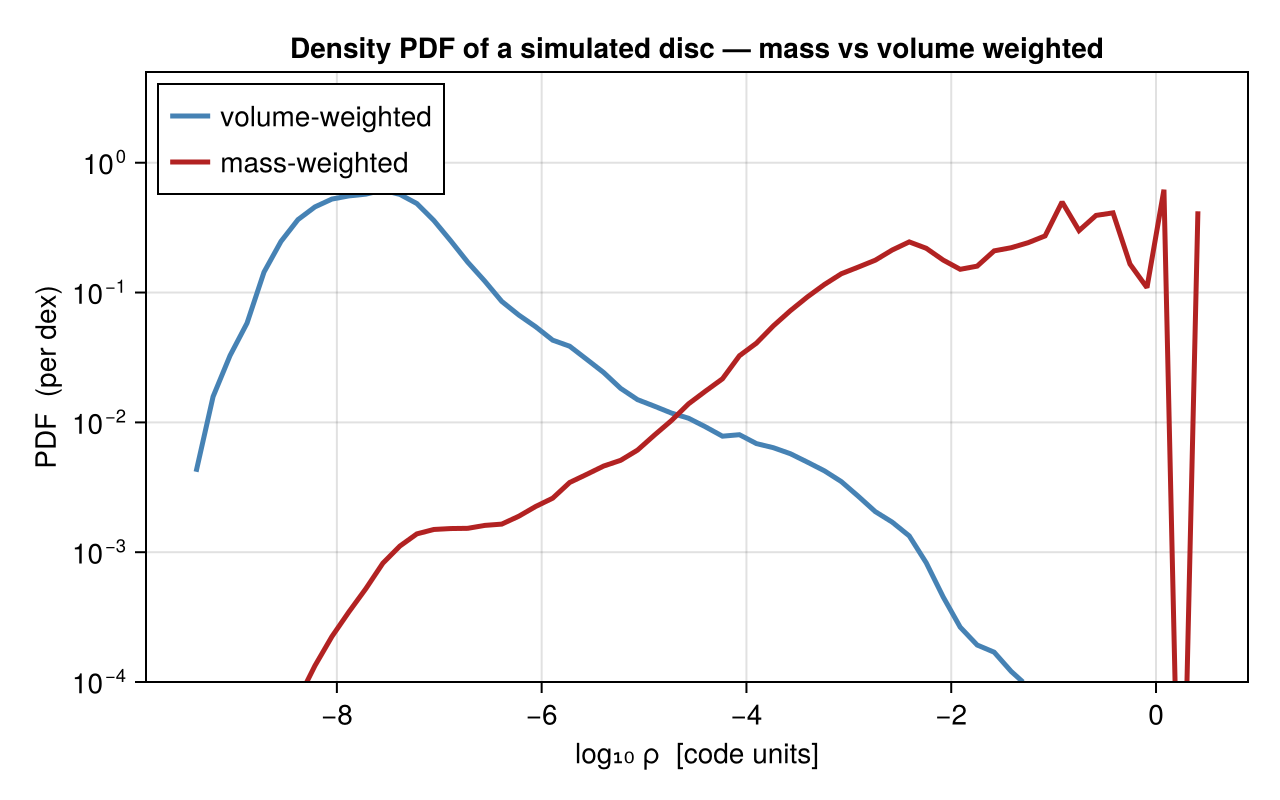
The weight decides what the PDF describes, and the two weightings tell different stories (as in the figure):
weight=:mass(default), "how much mass is at each density"; peaks at high density.weight=:volume, "how much volume is at each density"; the volume-weighted density PDF is the one compared with turbulence theory (the log-normal).weight=:cells/:count, number-weighted (every cell counts equally).
Options
| keyword | default | meaning |
|---|---|---|
weight | :mass | :mass, :volume, or :cells/:count |
norm | :density | :density (area = 1), :probability (Σ = 1), :peak (max = 1), or :count/:none (raw weighted counts) |
logbins | true | log-spaced bins over log10(quantity) (quantity must be > 0) |
bins | 60 | number of bins |
valrange | data range | (min, max) of the quantity |
unit | :standard | unit of quantity |
mask | [false] | restrict to selected cells/particles |
These are the keywords of the data-object form. A projection result takes the same list without unit and mask; the bare-matrix form takes weights (plural, an array the same shape as the map) rather than weight, since there is no data object to look a weighting up from.
The norm choices answer different questions: :density is the proper (bin-width-independent) PDF for comparing against theory or different binnings; :probability gives the mass/volume fraction in each bin; :peak compares shapes regardless of amplitude; :count keeps the raw weighted histogram.
It works on any quantity, not just density, e.g. pdf(gas, :T) (temperature), pdf(gas, :mach) (Mach number), pdf(gas, :p) (pressure). Combine with subregion or a mask to restrict to a region, and with timeseries to watch a PDF evolve.
Any data type, and projected 2D maps
pdf is generic over the data object, so it works on hydro, particle, gravity, and RT data, any quantity/weight getvar supports. For a signed field (the potential :epot, a velocity component) pass logbins=false, since log bins need positive values.
Pass a projection result and pdf takes the PDF of the 2D map's pixels, with :sd this is the column-density PDF (N-PDF), a standard observational diagnostic. Weight by :area (default, every pixel equal), :value, or another map key; a raw matrix works too (pdf(p.maps[:sd])):
parts = getparticles(info, verbose=false)
Pp = pdf(parts, :vx; weight=:mass, logbins=false)        # particle velocity PDF
println("particle vx PDF bins  : ", length(Pp.pdf))

grav = getgravity(info, verbose=false)
Pe = pdf(grav, :epot; weight=:volume, logbins=false)     # potential PDF
println("epot PDF bins         : ", length(Pe.pdf))

p = projection(gas, :sd; verbose=false)
N = pdf(p, :sd)                                          # area-weighted N-PDF of the map
println("map N-PDF bins        : ", length(N.pdf))
particle vx PDF bins : 60
Processing files: 100%|██████████████████████████████████████████████████| Time: 0:00:13 (21.37 ms/it)
✓ File processing complete! Combining results...
epot PDF bins : 60
Progress: 100%|█████████████████████████████████████████| Time: 0:00:01
map N-PDF bins : 60Plot the density PDF
using CairoMakie
fig = Figure(size=(560,400))
ax = Axis(fig[1,1], title="density PDF (mw_L10)", xlabel="log10 rho", ylabel="PDF")
lines!(ax, log10.(P.centers), P.pdf, label="mass-weighted")
lines!(ax, log10.(Pv.centers), Pv.pdf, label="volume-weighted")
axislegend(ax); fig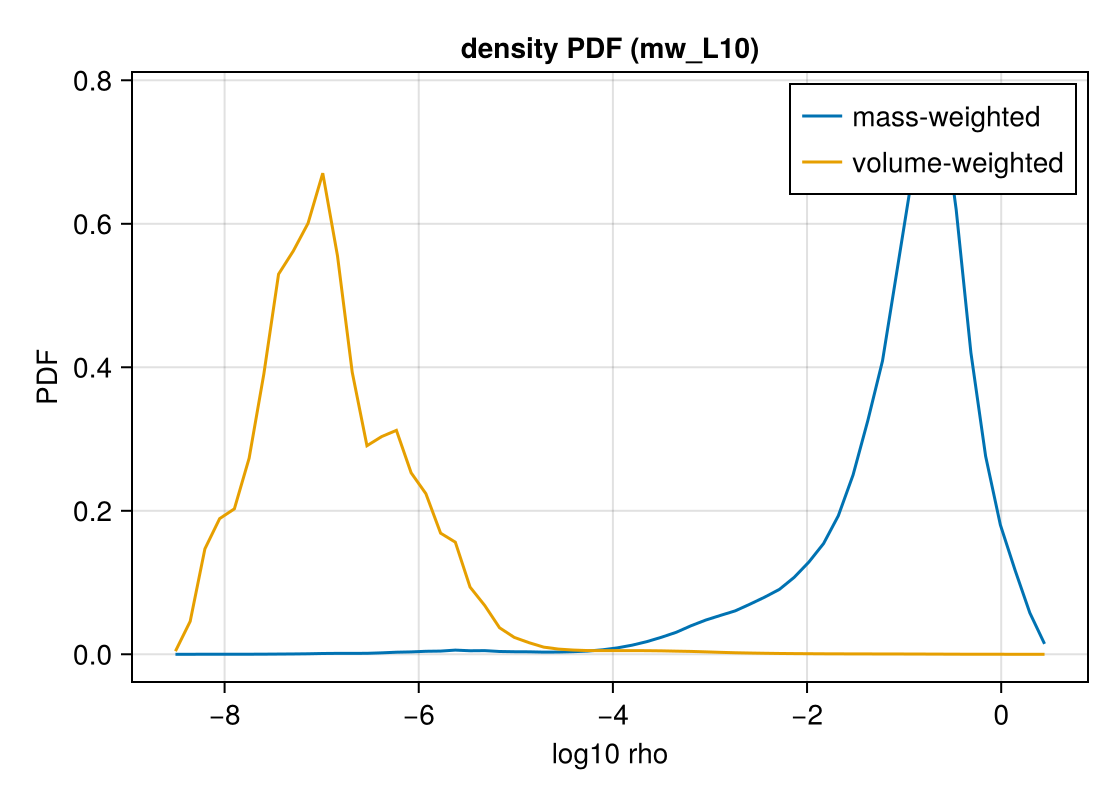
From a PDF to a number
A PDF is usually a step on the way to a number. With norm=:probability each bin holds the mass fraction in that bin, so "how much of the gas is denser than x" is a sum over bins.
Worth checking against the cells themselves, which need no binning at all:
P = pdf(gas, :rho; unit=:nH, norm=:probability)   # each bin = its share of the mass
n = getvar(gas, :rho,  :nH)
m = getvar(gas, :mass, :Msol)

for thr in (1.0, 10.0)
    f_pdf  = sum(P.pdf[P.centers .>= thr])       # bins whose centre is above the threshold
    f_cell = sum(m[n .>= thr]) / sum(m)          # the same question, asked of the cells
    println("above ", thr, " cm^-3 : PDF ", round(100*f_pdf, digits=2), " %",
            "   cells ", round(100*f_cell, digits=2), " %")
end
println("bin width: ", round(log10(P.edges[2]/P.edges[1]), digits=3), " dex")
above 1.0 cm^-3 : PDF 78.16 % cells 79.28 %
above 10.0 cm^-3 : PDF 25.59 % cells 22.18 %
bin width: 0.152 dexThe two do not agree exactly, and the reason is worth knowing rather than worrying about: the bin that straddles the threshold is counted whole or not at all, depending on which side its centre falls, so the PDF answer is only as sharp as the bins. Here that is 0.15 dex, and the answers differ by one to three percentage points, in either direction.
So: use the PDF for the shape, and the cells for the number. A threshold question has an exact answer without binning, from getvar as above or from filterdata if you want the selection itself. Raising bins narrows the disagreement but never removes it.
One quantity, two regions
A PDF becomes an argument when you compare two of them. Any region works, and the object a subregion returns goes straight back into pdf.
inner = subregion(gas, sphere(5.;  center=[:bc], range_unit=:kpc), verbose=false)
outer = subregion(gas, sphere(20.; center=[:bc], range_unit=:kpc) \
                       sphere(5.;  center=[:bc], range_unit=:kpc), verbose=false)

Pi = pdf(inner, :rho; unit=:nH, weight=:volume)
Po = pdf(outer, :rho; unit=:nH, weight=:volume)
println("inner  r < 5 kpc : ", length(inner.data), " cells")
println("outer 5 - 20 kpc : ", length(outer.data), " cells")

fig = Figure(size=(560,400))
ax = Axis(fig[1,1], xlabel="log10 nH  [cm⁻³]", ylabel="PDF per dex",
          title="volume-weighted density PDF, by region")
lines!(ax, log10.(Pi.centers), Pi.pdf, label="r < 5 kpc", linewidth=2)
lines!(ax, log10.(Po.centers), Po.pdf, label="5 – 20 kpc", linewidth=2)
axislegend(ax; position=:lt)
fig
inner r < 5 kpc : 3195277 cells
outer 5 - 20 kpc : 20413408 cells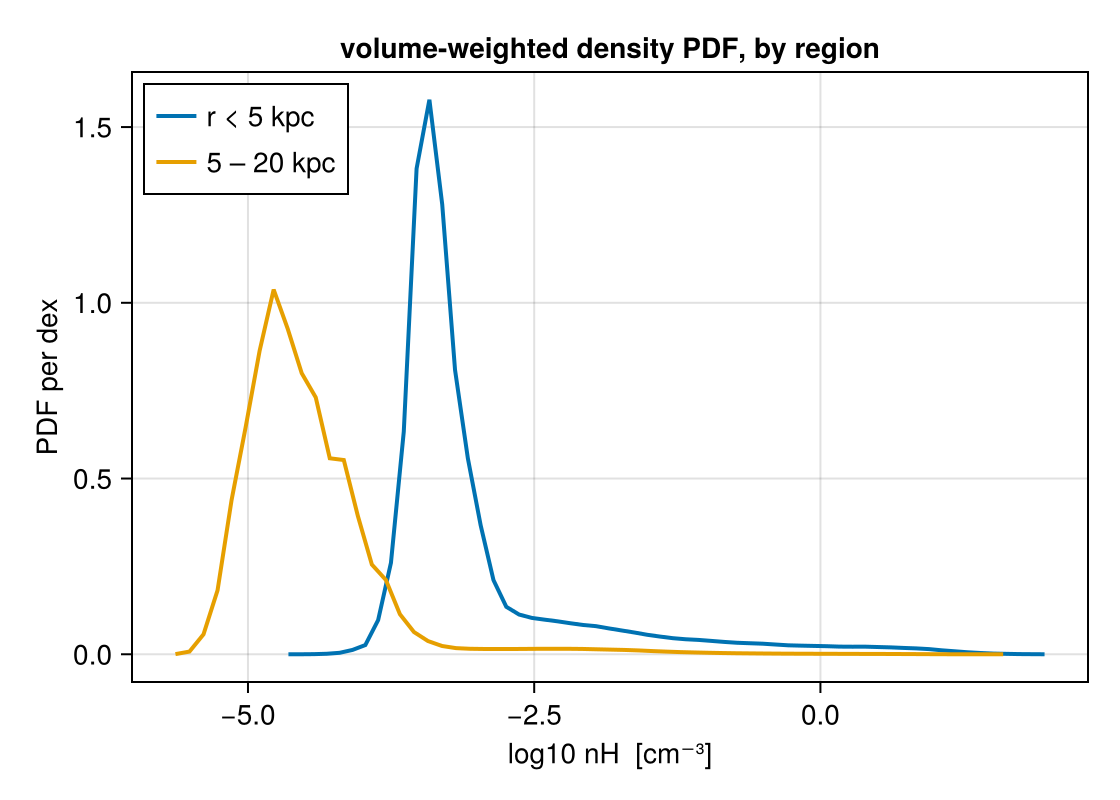
The inner disc peaks about a decade and a half higher in density and carries a long tail to the star-forming end; the outer shell is the diffuse envelope. Same function, same units, same binning, so the two curves are directly comparable.
Is it log-normal?
The density PDF of isothermal, supersonic turbulence is log-normal in $s = \ln(\rho/\rho_0)$, which is why the shape is worth measuring rather than admiring. wstat gives the weighted moments in one call, so the test is three lines.
V    = getvar(gas, :volume)
rho  = getvar(gas, :rho)
rho0 = sum(rho .* V) / sum(V)          # volume-weighted mean density
s    = log.(rho ./ rho0)

w = wstat(s; weight=V)                 # mean, median, std, skewness, kurtosis, extrema
println("sigma_s  = ", round(w.std, digits=3))
println("mean s   = ", round(w.mean, digits=3),
        "   a log-normal would give -sigma^2/2 = ", round(-w.std^2/2, digits=3))
println("skewness = ", round(w.skewness, digits=3), "   (0 for a log-normal)")
sigma_s = 1.819
mean s = -6.178 a log-normal would give -sigma^2/2 = -1.655
skewness = 1.724 (0 for a log-normal)And it is not, which is the useful answer. A log-normal has $\langle s \rangle = -\sigma_s^2/2$ and zero skewness; this snapshot gives $-6.18$ against $-1.66$, and a skewness of $1.7$. That is what a whole galaxy looks like: a cold star-forming disc, a warm envelope and a hot halo, sampled together. The log-normal is a statement about a single isothermal turbulent medium, so the honest way to test it is on a region that is one, which is what the section above sets up.
wstat is the general tool here, and takes any array with weight and mask. See Basic Calculations.
Planned
Density/velocity power spectra and structure functions are planned as a follow-up; they need an FFT backend and will ship as a package extension (using FFTW), the same way a FITS exporter uses FITSIO. Many derived quantities are already available through getvar, e.g. :freefall_time, :jeanslength/:jeansmass, :virial_parameter_local, the sound speed :cs, and the Mach numbers :mach*.
See also
getvar, the quantities you can take a PDF of (and the derived timescales).profile, radial/quantity profiles (means in bins), the complementary view.timeseries, evolve a PDF across snapshots.