Multi-code support
All of the readers below are exercised in one executable Jupyter notebook — open / download 16_multi_OtherCodes.ipynb. It loads PLUTO / Chombo / Athena++ / FLASH / GADGET, shows MHD / gravity / chemistry / RT fields, a load-time sub-region, and a save/load round-trip — and runs end-to-end as part of Mera's test suite.
Mera began as a RAMSES tool, but its analysis layer is code-blind: every quantity (getvar), map (projection), region (subregion), filter (filterdata), profile, PDF, time-series and clump finder works on a generic uniform/AMR cell list — not on any particular file format. A reader for another simulation code therefore only has to do one thing: fill the standard Mera structs (an InfoType + a HydroDataType whose cells follow Mera's (:level, :cx, :cy, :cz, <vars…>) convention). Everything downstream then runs unchanged.
That is the whole design: a new code = "write a reader that fills the structs", not "rework Mera".
Supported codes
The normal getinfo / gethydro entry points auto-detect the code from the files in the directory (override with code=); the detected code is stored in info.simcode.
| Code | File format | Grid | Data types | Native units | Load-time window | Block I/O pruning | Reader page |
|---|---|---|---|---|---|---|---|
| RAMSES | RAMSES binary | AMR | hydro · gravity · particles · RT · clumps | physical (from info) | ✅ | — (native) | (the tutorials) |
| PLUTO | grid.out + .dbl | uniform | hydro · particles | code (dimensionless) | ✅ | n/a (one .dbl read) | PLUTO |
| PLUTO-AMR / Chombo | Chombo HDF5 | AMR | hydro | code | ✅ | ✅ (per box) | PLUTO |
| Athena++ | .athdf HDF5 | AMR | hydro · MHD | code | ✅ | ✅ (per MeshBlock) | Athena++ |
| FLASH | HDF5 PARAMESH | AMR | hydro · MHD | CGS | ✅ | ✅ (per leaf block) | FLASH |
| GADGET (+ GIZMO/AREPO/SWIFT/TNG) | HDF5 PartType* | particles | particles · gas-cell physics (ρ · T · Z · …) | physical (a/h applied) | ✅ | ✅ (per type, on read) | GADGET |
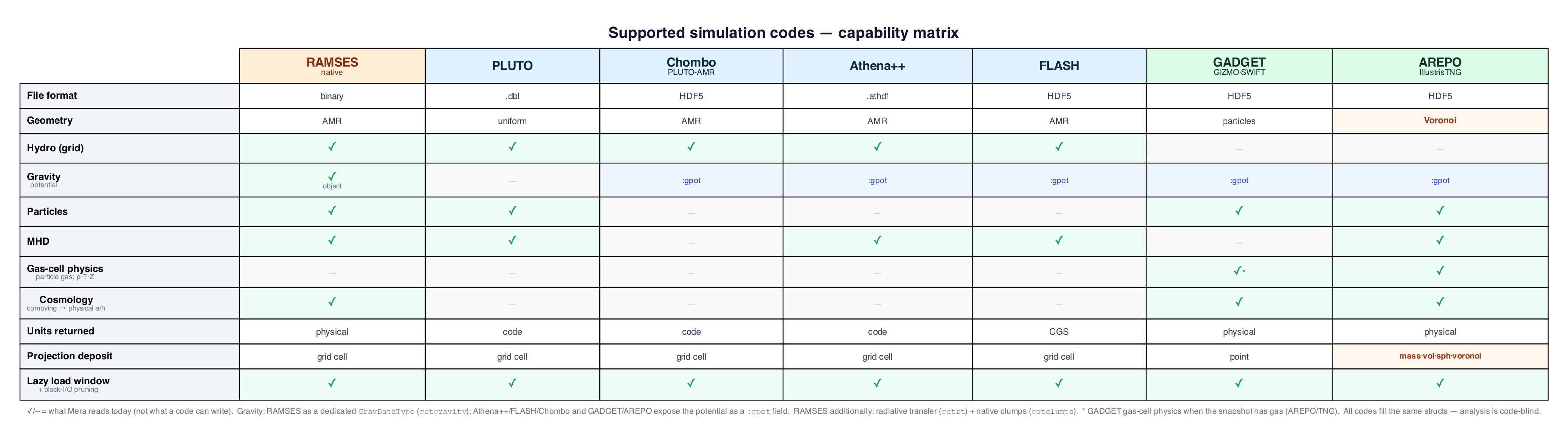
The same support at a glance — which capability each code carries (MHD, particle gas-cell physics, cosmological a/h, projection deposition modes):
Which entry point works on which code
Every reader registers itself with the entry points it implements, so the table below is generated from the reader registry at build time — it cannot drift from the code. Query the same information programmatically with supports(info, :gravity) / capabilities(info); an unsupported call fails fast with a message naming what IS available for that code.
Code (getinfo key) | simcode | getinfo | gethydro | getparticles | getgravity | getrt | getclumps | getgroups |
|---|---|---|---|---|---|---|---|---|
RAMSES (native AMR) (:ramses) | RAMSES | ✓ | ✓ | ✓ | ✓ | ✓ | ✓ | — |
Athena++ (.athdf) (:athena) | Athena++ | ✓ | ✓ | — | — | — | — | — |
Chombo / PLUTO-AMR (HDF5) (:chombo) | CHOMBO | ✓ | ✓ | — | — | — | — | — |
FLASH (PARAMESH HDF5) (:flash) | FLASH | ✓ | ✓ | — | — | — | — | — |
GADGET-HDF5 family (:gadget) | GADGET, AREPO, SWIFT, GIZMO | ✓ | — | ✓ | — | — | — | ✓ |
PLUTO (static uniform grid) (:pluto) | PLUTO | ✓ | ✓ | ✓ | — | — | — | — |
Data is loaded per type, exactly as for RAMSES: gethydro always, and getparticles where the code wrote particles (PLUTO). Only what a code actually stored is available — e.g. an Athena++/FLASH plot file is hydro + cell-centred MHD only.
The Chombo row above is a file format, not a physics code: Chombo is a block-structured AMR framework (Lawrence Berkeley National Laboratory) whose HDF5 output is shared by PLUTO (AMR mode), Orion, Charm, BISICLES and others. Mera reads any Chombo-format .hdf5 the same way — see PLUTO-AMR (Chombo).
Self-gravity rides along the same way: where a code writes a gravitational potential into its snapshot (Athena++ phi, FLASH gpot, Chombo gravitational-potential) the reader exposes it as a single canonical field, so getvar(gas, :gpot) — and projection, timeseries, … on it — runs identically on every code.
Chemistry & radiative transfer follow suit. A code's species abundances (Athena++ writes its chemistry networks as rH/rH2/rCO/rH+/…) are mapped to canonical fractions — :xHI, :xH2, :xCO, :xHII, … — and radiation-transport fields to canonical names too: nr_radiation energy/flux → :Erad/:Frad_*, and a six-ray chemistry run's per-frequency mean intensities (ir_avg0…7) → photon groups :Np1…:Np8 (the RAMSES-RT convention). Because these land as direct columns, getvar(gas, :xH2) or getvar(gas, :Np1), a projection of either, or a timeseries of an abundance runs the same on every code that writes them. RAMSES RT runs keep their own descriptor-based getvar species; the canonical names are the shared vocabulary.
A full PDR run (gow17 C/O chemistry + six-ray transfer) needs an implicit ODE solver — the stiff network overruns the forward-Euler solver, so the run is built against CVODE (SUNDIALS); the Radiative transfer (PDR) example below is one such run. Mera's reading of all 12 species and the 8 photon-group fields is independent of the solver.
Particles load through getparticles into a PartDataType, code-blind too: PLUTO Lagrangian particles, and the GADGET HDF5 family (GADGET/GIZMO/AREPO/SWIFT/EAGLE/TNG) with its gas/DM/star particle types — so msum, center_of_mass, getvar and projections run the same on a RAMSES halo or a GADGET galaxy. (Athena++/FLASH particle reading is not yet wired.)
Multi-output workflows are code-blind too: timeseries and getmovie/savemovie discover the output numbers in a directory per format (*.NNNNN.athdf, *_hdf5_plt_cnt_NNNN, PLUTO's dbl.out, …) and iterate them through the generic loader — so a time-series or movie reduction runs the same call on every supported code.
Worked examples: self-built runs
These three small Athena++ runs (built from source, regenerable, a few MB each) exercise the multi-code workflow end to end — multi-output time series, self-gravity, and chemistry — each loaded and analysed with the same calls used for RAMSES.
MHD blast (time series)
A 3-D MHD blast (32³ root + 2 adaptive-AMR levels, 11 HDF5 outputs). getinfo reads one snapshot:
julia> info = getinfo(5, "/data/athena_blast");

Code: Athena++
output: 5  time: 0.50111 [code units]
root grid: 32³ (level 5), MaxLevel 2 ⇒ levels 5:7, boxlen = 2.0
MeshBlocks: 148   variables: (rho, p, vx, vy, vz, bx, by, bz)
-------------------------------------------------------
and timeseries reduces all 11 outputs with the same call used for RAMSES — here the peak density and field strength over time:
ts = timeseries("/data/athena_blast",
                d -> (rmax = maximum(getvar(d, :rho)), bmax = maximum(getvar(d, :bmag)));
                time_unit = :standard)
#  output | time | rmax  | bmax       (ρ_max rises 1.0 → 2.1 as the blast forms;
#  ───────┼──────┼───────┼─────       the blast elongates along B — top row below)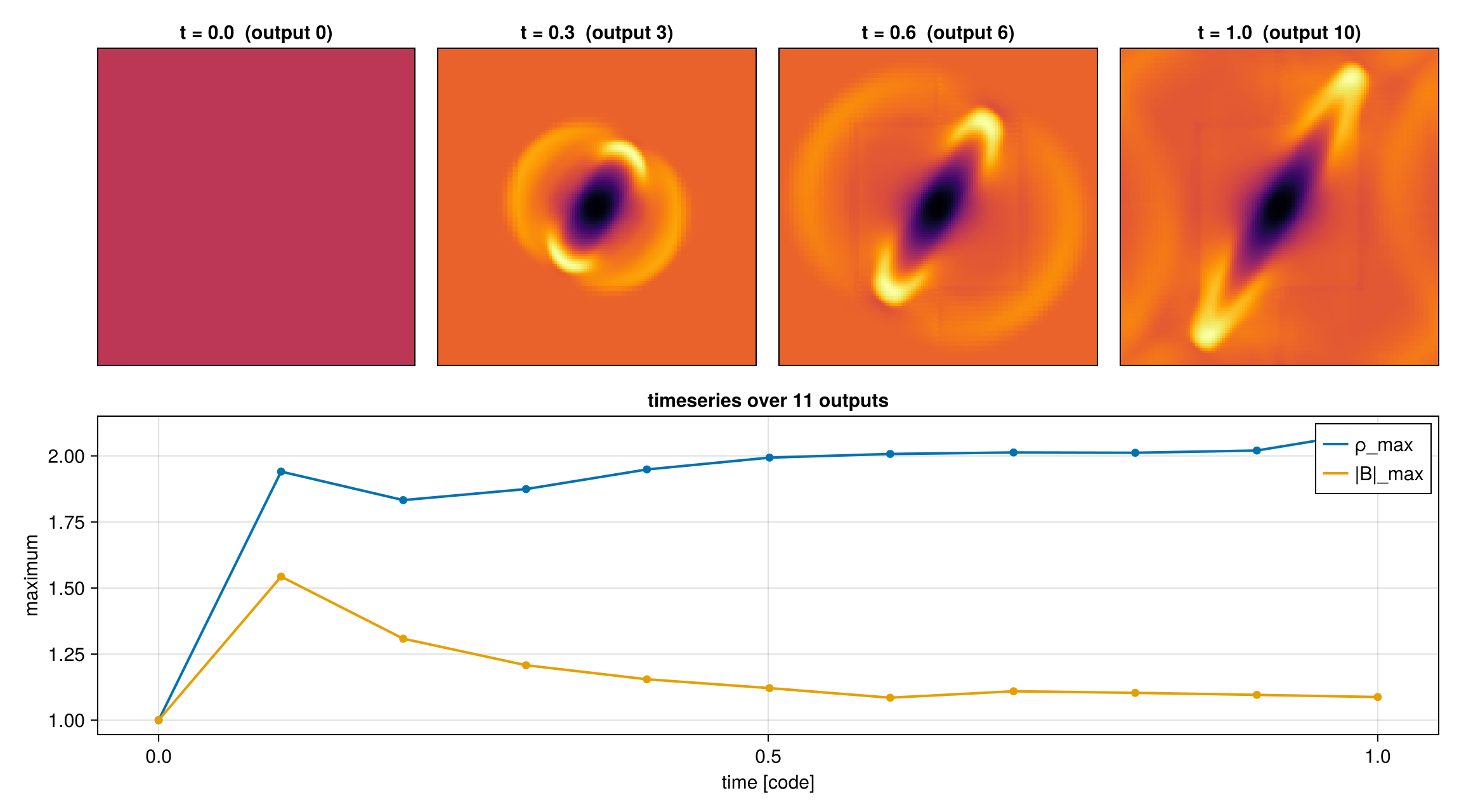
Every snapshot can also be written to Mera's portable JLD2 format (savedata/loaddata) — converting any supported code into mera-files that the whole toolchain (including timeseries(…; mera_files=true)) then reads back identically.
Self-gravity
A Jeans run with self-gravity (multigrid) writes the gravitational potential, which the reader exposes as the canonical :gpot field — getvar/projection/timeseries then treat it like any other quantity:
gas = gethydro(getinfo(2, "/data/athena_selfgravity"))
projection(gas, :gpot)                       # the potential well tracking the density (right panel)
projection(gas, :rho)                        # the Jeans-mode density perturbation (left panel)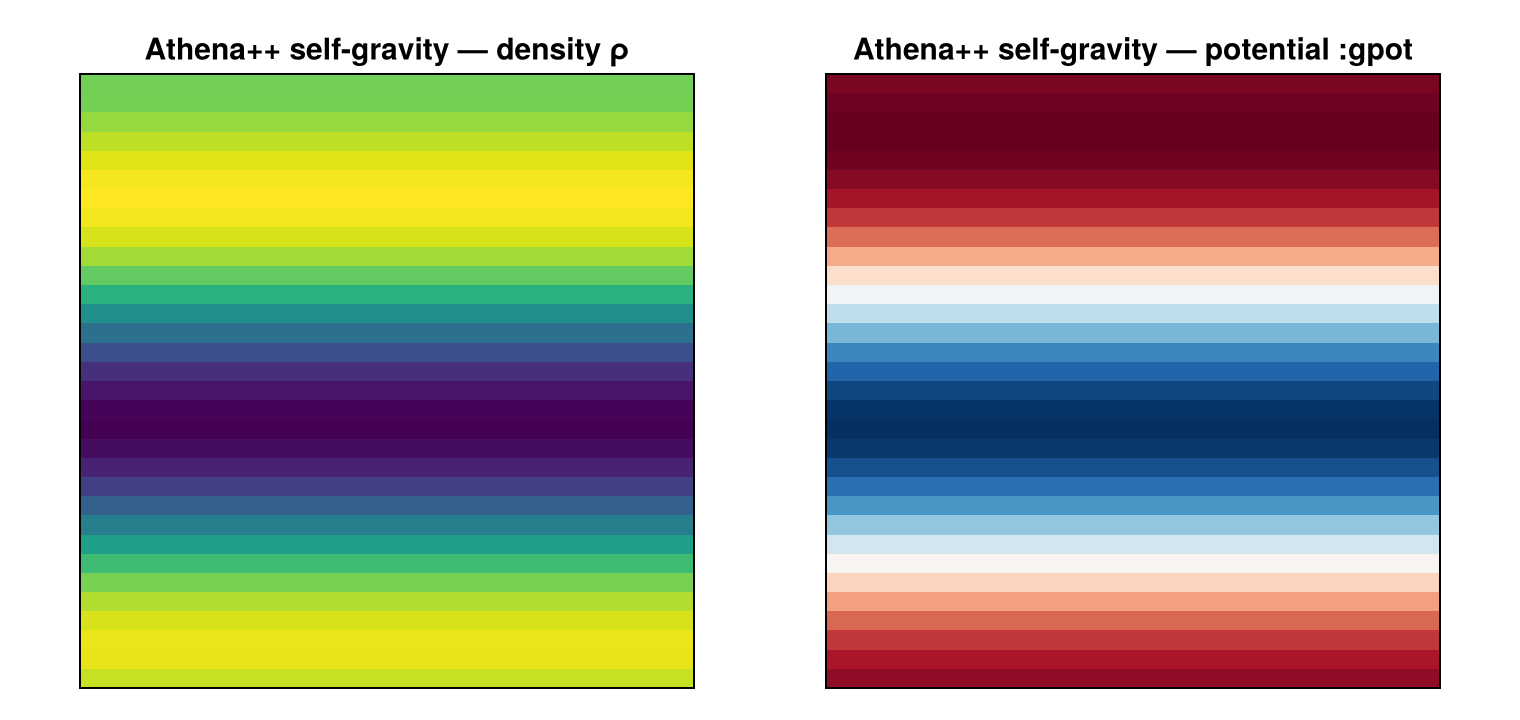
Chemistry
A run with the H₂ chemistry network writes the species abundances, mapped to canonical fractions :xHI/:xH2. A timeseries of a species is the same call as any other reduction — here the H→H₂ formation over 50 Myr:
ts = timeseries("/data/athena_chemistry",
                d -> (xHI = getvar(d, :xHI)[1], xH2 = getvar(d, :xH2)[1]);
                time_unit = :standard)
#  output | time | xHI  | xH2     (xH2 rises 0 → 0.45 as molecular hydrogen forms)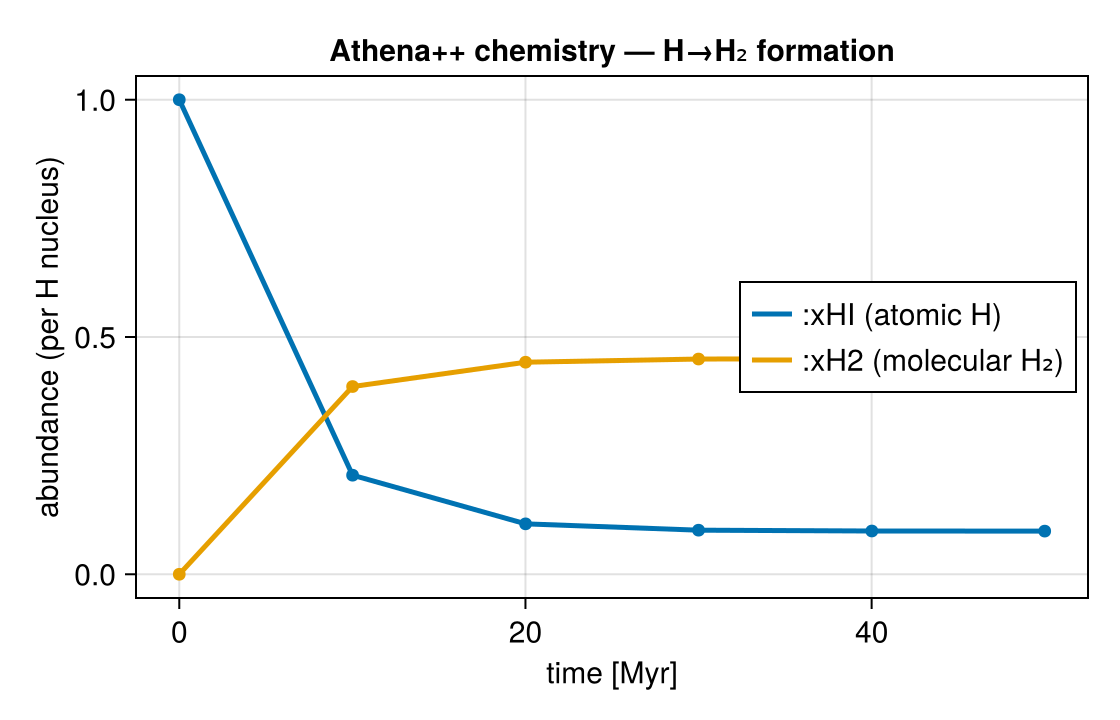
Radiative transfer (PDR)
A photo-dissociation region: gow17 (C/O) chemistry + six-ray radiative transfer (CVODE solver). The eight radiation frequency bins load as photon groups :Np1…:Np8, the species as canonical fractions — so the whole PDR stratification is just getvar/projection:
gas = gethydro(getinfo(5, "/data/athena_sixray"))
projection(gas, :Np1)                        # the UV radiation field, attenuated into the cloud
projection(gas, :xH2)                        # molecular H₂, forming in the shielded interior
projection(gas, :xCII)                       # ionized carbon, at the UV-exposed surface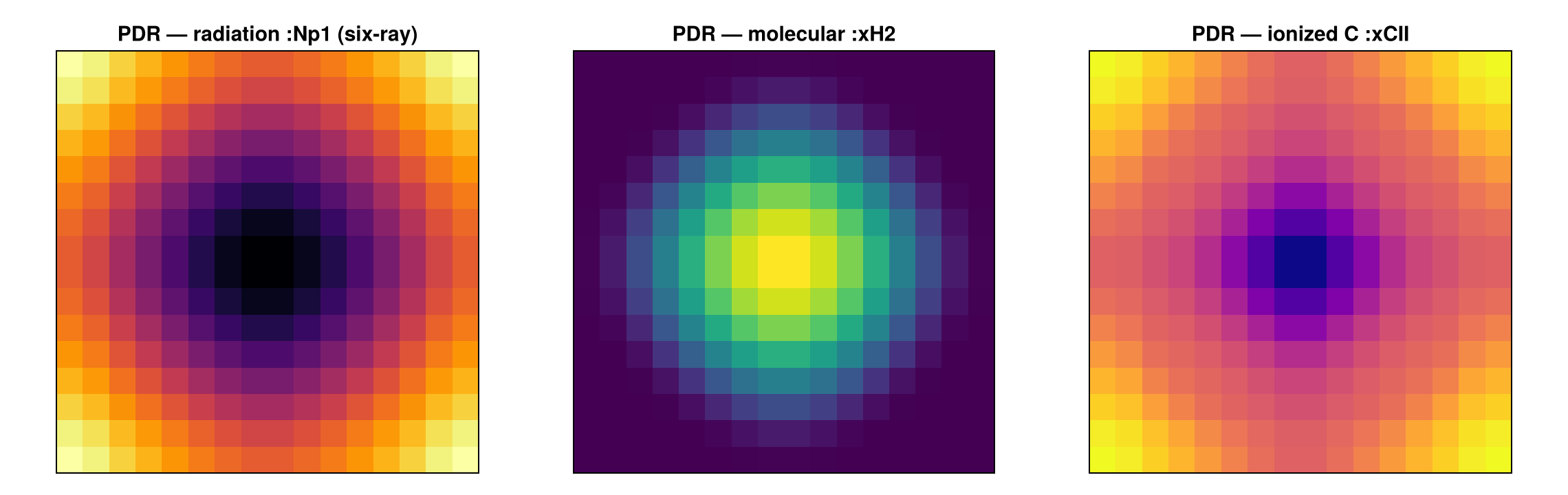
The shared contract
Whatever the source code, a loaded object obeys the same rules — this is what makes the analysis code-blind, and what the cross-reader test (test/59_multicode_contract_tests.jl) checks:
- Cell convention. A cell at
levelwith 1-based integer indexcxspans[(cx−1), cx]·boxlen/2^level, so its centre isgetvar(:x) = (cx−0.5)·boxlen/2^level(likewisecy,cz); its size isboxlen/2^level. AMR readers carry a:levelcolumn; uniform readers have a single level. - Exact tiling. The leaf cells cover the box with no gaps or overlaps —
Σ getvar(:volume) = boxlen³. This is the decisive correctness check every reader is validated against on real data. - Spatial selection.
gethydro(info; xrange, yrange, zrange, center, range_unit)selects a window at load time (HDF5 AMR readers read only the intersecting blocks); the result equals a full load filtered bygetvar(:x), and the window is recorded inobj.ranges. Level/resolution is not a load argument — on a leaf-cell list a level cap would leave holes — it is chosen at analysis time (projection(…, res=)).
How mature is each reader?
Mera was built for RAMSES and grew outward, so the readers are not equally mature, and it is worth being plain about that before you plan work around one.
| Code | What is implemented | How it is tested | Use it for |
|---|---|---|---|
| RAMSES | getinfo, gethydro, getparticles, getgravity, getrt, getclumps | real simulation outputs, the great majority of the suite's ~6100 assertions | production work; this is the path everything else is measured against |
| GADGET family (GADGET, AREPO, SWIFT, GIZMO, TNG) | getinfo, getparticles, getgroups | ~230 assertions against synthetic HDF5 fixtures | particle and gas-cell analysis; the widest non-RAMSES coverage |
| PLUTO | getinfo, gethydro, getparticles | ~80 assertions against synthetic fixtures | uniform-grid and Chombo-AMR runs |
| Athena++ | getinfo, gethydro | ~66 assertions against synthetic fixtures | grid/MHD analysis |
| Chombo | getinfo, gethydro | ~26 assertions against synthetic fixtures | AMR hydro analysis |
| FLASH | getinfo, gethydro | ~40 assertions against synthetic fixtures | grid/MHD analysis |
Two honest caveats:
Only RAMSES has dedicated getgravity, getrt and getclumps, because RAMSES writes those to separate files. Where another code stores the same physics inside its snapshot, the reader maps it to the canonical field — but there is no separate entry point, and no equivalent of the clump finder's RAMSES-specific catalogue reader.
The non-RAMSES readers are exercised against synthetic fixtures, which pin down the format contract — geometry, units, cell conventions, the shared contract below — rather than behaviour across the full variety of real runs. They are correct on what they are tested for. If you point one at a production simulation with an unusual configuration, you are in less well-trodden territory than a RAMSES user is.
None of this is a reason to avoid them. It is a reason to check your first result against something you trust, and to tell us when it disagrees.
Help us widen this
The analysis layer is code-blind by design, so broadening code support is mostly reader work, not core work — which makes it unusually good ground for contributions.
The most useful things you can do, roughly in order of value to other users:
- Report a mismatch. If a reader disagrees with the code's own tools, or with yt, on the same snapshot, that is the highest-value bug report we can get. Open an issue with the code, the configuration, and what differed.
- Share a small real snapshot. The synthetic fixtures are what limit confidence above. A compact, redistributable output from a real run — especially with an unusual setup — lets us turn a contract test into a behaviour test.
- Extend a reader. Adding particles to a grid code, or gravity where the snapshot carries it, is self-contained work; see Adding a reader.
- Write a new reader. The contract is small and the downstream analysis comes free.
Questions and work-in-progress are welcome in issues and discussions — including "is this supposed to work?", which is often the fastest way to find a gap in the docs.
Reference readers
Each frontend is built to agree with the upstream tools that define its format — yt's per-code frontends and region selectors, and each code's own reader (pyPLUTO, Athena++'s athena_read.py, the FLASH user guide). The reader pages cite these as the origin the implementation is validated against; the yt sample-data collection supplies the real test snapshots.
Adding a reader
The design doc docs/dev/MULTICODE_READERS.md walks through it. In short: write getinfo_X(output, path; …) → InfoType (set simcode, levelmin/max, boxlen, unit_*, variable_list, then createconstants!/createscales!) and gethydro_X(info; xrange, …) → HydroDataType, reusing the shared _external_ranges/_external_keep helpers for load-time selection. Then add a detect_simcode branch and the getinfo/gethydro router branches, and export the two functions. Mirror the existing HDF5 readers (reader_athena.jl, reader_flash.jl) for block-structured AMR.