Profiles & Phase Diagrams
For a runnable walk-through (radial/vertical profiles, per-bin statistics, mass vs volume weighting, stars/gravity, profiles from 2-D maps, phase diagrams): see the Profiles & phase diagrams tutorial.
profile and phase are general weighted reductions over any getvar fields: they are not tied to projection or to a line of sight. A profile bins the data by one field; a phase diagram is a 2D weighted histogram of two fields. They work on
- 3D data: hydro, gravity, particles and clumps, using each type's available fields. (Gravity carries no
:mass, so weight by:volume/:none; clumps expose only their stored columns,:mass,:peak_x/y/z,:rho_av, …, not derived coordinates like:r_cylinder.) - projected 2D maps: a
projectionresult, viaprofile(m::DataMapsType, …)/phase(m::DataMapsType, …)(the returns carrysource=:map); see the tutorial.
Over the full data range (the default xrange) the binned weights sum to the grand total, e.g. a radial mass profile sums to the total mass. Restricting xrange/edges instead sums only the weight inside that range.
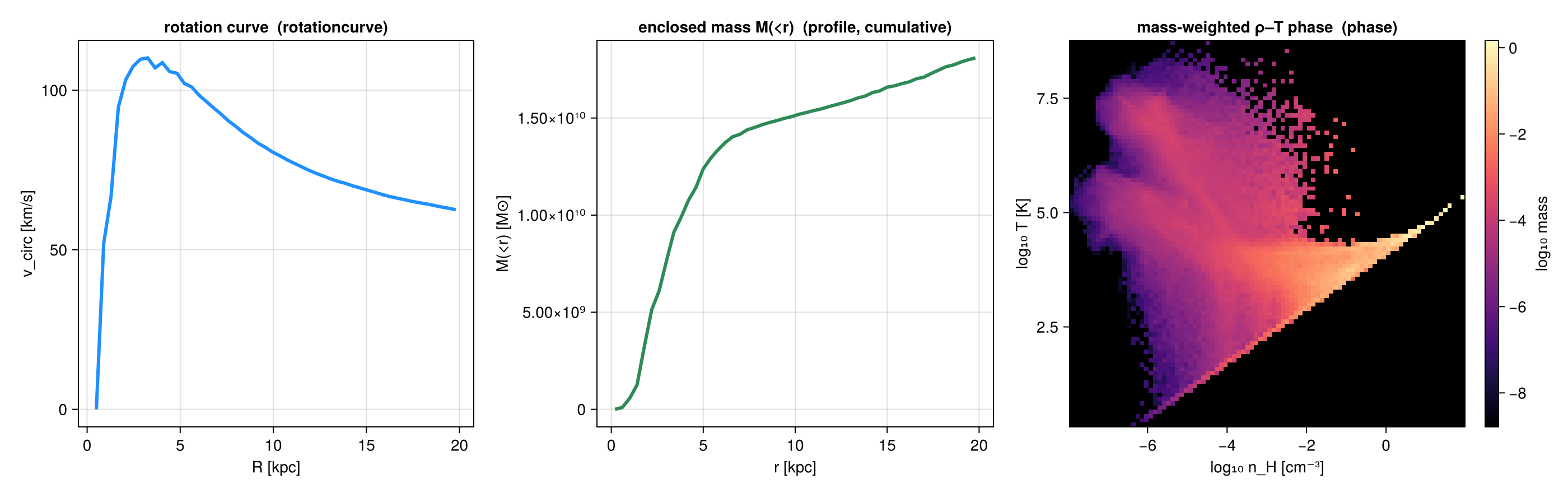
What you can compute
A profile is configurable along a few independent axes: mix and match freely.
Data source: 3-D data (profile(obj, …)) or a projected 2-D map (profile(m::DataMapsType, …)).
Per-bin reduction: with a yvar, every bin returns all of these at once:
| reduction | field(s) | notes |
|---|---|---|
| count / summed weight | count, sum, sumw2 | always returned; sum = Σweight (the mass/volume/… profile) |
| weighted mean | mean | |
| standard deviation | std | weight-weighted |
| standard error of the mean | sem, neff | sem = std/√neff (Kish effective sample size) |
| median & percentiles | median, quantiles, qlevels | weighted; set the levels via quantiles=[…] |
| extrema | min, max | |
| shape moments | skewness, kurtosis | weighted; kurtosis is excess (0 for a Gaussian) |
| custom | custom | statistic = f(yview, wview) (or f(yview)) |
Weighting: weight = :mass · :volume (grid only) · :none (equal cells) · any field. (Should be non-negative.) Binning: nbins + xrange + scale=:linear/:log/:equal (quantile-spaced adaptive bins, ~equal count per bin, robust for sparse outer radii / noisy data), or explicit edges=[…]. :log is base 10, not natural log: the edges are 10 .^ range(log10(lo), log10(hi), …), so a binsize under :log is a dimensionless dex step (0.1 = ten bins per decade). The same holds for xscale/yscale/zscale in phase and profile3d. Values ≤ 0 have no log bin and are dropped with a warning. Reference point: center in center_unit (e.g. center=[24,24,24], center_unit=:kpc); the binning-axis unit is xunit, not center_unit (the axis can be any quantity). range_unit is a back-compat alias of center_unit.
One-line transforms (opt-in):
| want | kwarg | adds |
|---|---|---|
| physical density ρ(r) / Σ(R) | geometry=:spherical / :cylindrical | shell_volume, density |
| cumulative / enclosed M(<r) | cumulative=:forward / :reverse | cumsum, cumcount |
| normalized histogram (fractions / PDF) | normalize=:sum / :pdf | fraction, pdf |
| bootstrap uncertainties | bootstrap=N (ci=:percentile/:basic/:bca) | mean_ci, median_ci (nbins×2), median_se |
| several fields in one pass | yvar = [:a, :b] | fields[:a], fields[:b], yvars |
Normalizations: fractions, PDFs & density PDFs. With no yvar, the binned sum is a histogram of weight; normalize=:sum → fraction = sum/Σsum (bins add to 1); normalize=:pdf → pdf = fraction/Δedge (a true probability density, ∫ = 1, bin-width independent). The classic case is the density PDF, bin by :rho and normalize; weight=:mass vs :volume give the mass- vs volume-weighted ρ-PDF. The same normalize=:pdf makes a 2-D PDF in phase and a 3-D PDF in profile3d. (Worked, plotted example: tutorial §3.)
Bin widths by count, physical size, or population. Set bins by count (nbins+xrange), physical width (binsize), or explicit edges:
| you want | pass | note |
|---|---|---|
n bins over a range | nbins=40, xrange=(0,20) | default |
a fixed width Δ (in xunit) | binsize=0.5 | e.g. 0.5-kpc radial bins; overrides nbins |
| a width with its own unit | binsize=(500,:pc) | converted to xunit; final bin may be short (keeps the top edge) |
| a fixed dex step (log) | scale=:log, binsize=0.25 | log10-spaced; binsize is a dimensionless dex step |
| ~equal points per bin | scale=:equal | quantile-spaced adaptive bins (no binsize) |
| exact edges | edges=[…] | in xunit; wins over everything |
(phase/profile3d take per-axis xbinsize/ybinsize/zbinsize.)
Result fields: quick reference
What a profile returns (a NamedTuple; only the relevant fields are present):
| field(s) | shape | when |
|---|---|---|
x, edges, count, sum, sumw2 | nbins (edges: nbins+1) | always (sum = Σweight) |
mean, std, var, sem, neff, min, max, median, skewness, kurtosis | nbins | with a yvar |
quantiles, qlevels | nbins×nq, nq | with a yvar |
shell_volume, density | nbins | geometry=:spherical/:cylindrical |
cumsum, cumcount | nbins | cumulative=:forward/:reverse |
fraction (+ pdf) | nbins | normalize=:sum (:pdf) |
mean_ci, median_ci, median_se, ci_level, ci_method, nboot | nbins×2 / nbins | bootstrap=N |
custom | nbins | statistic=f |
fields[:name], yvars | per field | vector yvar (each field nests the per-bin stats above) |
weight, xvar, yvar, xunit, unit, source | , | provenance (weight=:vector for a raw-vector weight) |
Choosing the tool
| tool | bins | output | per-bin value | typical use |
|---|---|---|---|---|
profile(obj, x[, y]) | 1 | nbins | Σweight, or stats of y | radial ρ(r), rotation curve, ⟨T⟩(r), PDFs |
phase(obj, x, y[, c]) | 2 | nbins² (H) | joint Σweight; cstat of c | ρ-T diagram, joint PDF |
profile3d(obj, x, y, z[, c]) | 3 | nbins³ (H) | joint Σweight; cstat of c | ρ-T-Z cube; marginal ≡ phase |
velocitydispersion(obj) | 1 (radius) | nbins | σR/σφ/σ_z + total σ | kinematic dispersion profile |
profiletimeseries(loadfn, outs, …) | 1 × snapshots | nbins×nsnap | a profile per snapshot | radius-vs-time evolution |
profile(gas, :rho, :T) is the conditional ⟨T⟩(ρ), one curve, the mean of T given ρ. phase(gas, :rho, :T) is the joint distribution H[ρ,T]. They agree at the margin: sum(phase.H, dims=2) equals profile(gas, :rho).sum on the same x-edges.
Velocity dispersion
The per-bin std of a velocity component is already its rest-frame kinematic dispersion (weighted variance about the per-bin mean, net rotation/streaming does not inflate it), so profile(gas, :r_cylinder, :vz).std is σz(R), `…, :vϕcylinder).stdis σ_φ(R), etc. [velocitydispersion`](@ref) is a convenience wrapper that returns σR / σφ / σz (cylindrical by default) and the total σ = √(σR²+σφ²+σz²) in one call. (Worked example: the tutorial's "More features" section.)
Turbulent ⊕ thermal = total line width
The σ above is the turbulent (bulk) motion only. The width a spectrograph actually measures also includes the gas thermal motion. Pass thermal=true (with mu, the tracer mean molecular weight in H-atom masses: 2.33 molecular, 1.0 atomic, 0.6 ionized) to also get, per bin, the 1-D turbulent sigma_turb_1d = √(Σσ_i²/n), the thermal speed sigma_thermal = √(k_B⟨T⟩/(μ m_H)), the total sigma_total = √(sigma_turb_1d² + sigma_thermal²), and the turbulent Mach number mach = sigma_turb_1d/⟨c_s⟩:
vt = velocitydispersion(gas; thermal=true, mu=2.33, nbins=20, xrange=(0,18), center=[:bc], center_unit=:kpc)
vt.sigma_total      # √(turbulent² + thermal²)  [km/s]
vt.mach             # σ_turb,1D / c_s
Local (patch-de-streamed) dispersion: localdispersion
velocitydispersion removes the mean per radial bin, so a velocity gradient across a wide annulus (shear, spiral streaming) leaks into "turbulence". localdispersion instead tiles the (x, y) plane into square patchsize patches and removes the per-patch mean velocity, the TIGRESS/SILCC way to isolate turbulence below a chosen length scale. Restrict the input first (e.g. shellregion to an annulus), it returns aggregate scalars over the supplied region, with the turbulent/thermal/total σ, Mach, anisotropy, and the patch-to-patch percentile spread (usable as error bars):
solar = shellregion(gas, :cylinder, radius=[7,9], height=2, center=[:bc], range_unit=:kpc)
ld = localdispersion(solar; patchsize=[500,:pc], thermal=true, mu=2.33)
ld.sigma_total, ld.mach, ld.anisotropy, ld.sigma_total_q # scalars + (16,50,84)% patch spreadThe binned mean azimuthal velocity, profile(gas, :r_cylinder, :vϕ_cylinder), keeps the disk's rotation sense, so it can be negative (this galaxy's ⟨vϕ⟩ ≈ −230…−100 km/s). Plot abs.(mean) if you want a positive curve. For the curve set by the mass rather than by the gas motion, take it from the solved gravity field: `v = √(R·|aR|)withgetvar(grav, :ar_cylinder)`, which needs no assumption about how the mass is arranged.
Profiles from 2-D maps
profile(m::DataMapsType, var; xvar=:r, …) bins the pixels of a projection result: a surface-brightness Σ(R), a column-weighted vlos(R) (weight=:sd), a σlos(R), or any map vs any map. It works for axis-aligned and off-axis maps: xvar=:r measures radius from the object centre (the map's cextent/pivot), so the profile is correctly centred for asymmetric FOVs and off-axis views; pass center=[cx,cy] (camera-plane, in center_unit) to offset it. (Worked examples, including off-axis: the tutorial's "More features" section.)
These are box-axis / camera-independent reductions; for line-of-sight distributions (per-pixel spectra, velocity cubes) see the Off-axis Projection guide.
API
Mera.profile — Function
profile(dataobject, xvar [, yvar]; weight=:mass, nbins=50, xrange=nothing, scale=:linear,
        edges=nothing, geometry=:none, cumulative=:none, normalize=:none, statistic=nothing,
        xunit=:standard, unit=:standard, center=[:bc], center_unit=:standard,
        quantiles=[0.16, 0.5, 0.84], mask=[false],
        bootstrap=0, ci=:percentile, confidence_level=0.95, bootstrap_seed=20240601) -> NamedTuple
1D profile from 3D data. Bin by xvar and reduce yvar (or the weight itself) per bin. Any getvar fields, for hydro / gravity / RT / particle data; the classic use is a radial profile with xvar a length (:r_cylinder, :r_sphere, :z, …) about a physical center. (Clumps expose only their own catalogue columns — they have no :mass/:rho/:r_sphere getvar field — so radial/mass profiles are not available for clump data.)
weight—:mass,:volume,:none(equal weights), or any field; should be non-negative (negative summed weights make the weighted mean/std/quantiles ill-defined →NaN). Mass/volume weighting works for any data type that has that field (:volumeis grid-only; particles use:mass).center/center_unit— reference point and its unit (e.g.center=[24,24,24], center_unit=:kpc).range_unitis accepted as a back-compat alias ofcenter_unit.xrange=(lo,hi)(end point) inxunit(the binning axis can be any quantity, so its unit isxunit, notcenter_unit/range_unit— unlike the spatialxrangeofprojection).xunit/unitset the x-axis /yvarfield units.scale—:linear(default),:log, or:equal(quantile-spaced adaptive bins so every bin holds ~the same number of points — robust for sparse outer radii / noisy data).:logis base 10: the edges are10 .^ range(log10(lo), log10(hi), length=nbins+1), the low edge is clamped to the smallest positive value, and non-positive values are dropped with a warning (they have no log bin). Under:log,binsizeis therefore a dex step (a dimensionless number, 0.1 = ten bins per decade), not a width inxunit.bootstrap=N(>0) — also return bootstrap confidence intervals for the per-bin mean and median by resampling each binNtimes (default off).ciselects the interval::percentile(default),:basic, or:bca(bias-corrected & accelerated).confidence_level(default 0.95) and a fixedbootstrap_seed(deterministic). Addsmean_ci/median_ci(nbins×2: lower, upper) +median_se. Cost isO(bootstrap·N_bin)per bin (:bcaadds anO(N_bin²)jackknife) — meant for modest counts.quantiles— percentile levels for the per-bin weighted quantiles (default 16/50/84%).edges— an explicit vector of bin edges (overridesnbins/xrange/scale); given inxunit.geometry—:spherical(shell volume4/3·π·(r₂³ − r₁³)) or:cylindrical(annulus areaπ·(r₂² − r₁²)) addsshell_volumeand adensity = sum / shell_volume(e.g. a radial ρ(r) or surface density), inweight-unit perxunit³ (xunit²). Pair withxvar=:r_sphere/:r_cylinder.cumulative—:forward(low→high) or:reverseaddscumsum/cumcount(e.g. enclosed mass M(<r)).normalize—:sumaddsfraction = sum/Σsum(bins sum to 1);:pdfalso addspdf = fraction/Δedge(integral = 1).statistic— a function applied per bin (called asf(yview, wview)if it accepts weights, elsef(yview)) returning a scalar; result incustom. Needsyvar.
yvar may be a vector of fields ([:T, :rho]): the data is binned once and each field is reduced in the same pass — the per-field statistics are returned under fields (e.g. p.fields[:T].mean) with the order in yvars.
Returns x (centres), edges, count, sum (Σ weight), sumw2 (Σ weight²); with a single yvar also weighted mean, std, sem (standard error on the mean via Kish neff), min, max, median, a quantiles matrix (nbins × length(qlevels)), and the weighted shape moments skewness and kurtosis (excess kurtosis — 0 for a Gaussian). (bootstrap adds the CI fields.)
profile(m::DataMapsType, var; xvar=:r, weight=:none, nbins=50, xrange=nothing, scale=:linear,
        edges=nothing, geometry=:none, cumulative=:none, statistic=nothing,
        xunit=:standard, center=nothing, center_unit=:standard, quantiles=[0.16,0.5,0.84])
    -> NamedTuple
1D profile from a projected 2D map (a projection result). Bin the pixels of m.maps[var] by xvar and reduce per bin with the same statistics as the data method. xvar is
:r— image-plane radius fromcenter(a surface-brightness / Σ(R) profile),:x/:y— an image-plane coordinate, or- another map key — bin one map against another (any map vs any map).
weight is :none/:area (equal pixels) or another map key (e.g. weight=:sd for a column-weighted profile of :vlos). For the :r/:x/:y cases center (default: the map centre) is in center_unit (range_unit accepted as an alias) while xrange is in xunit (the radius is converted from code units via the map's scale). edges, geometry (:cylindrical annulus area for a 2-D map), cumulative and statistic work as in the data method.
Returns
The same per-bin statistic fields as the data profile method, plus var (the binned map variable), xvar, weight, xunit, unit (the mapped variable's unit, from the projection), and source=:map.
Mera.phase — Function
phase(dataobject, xvar, yvar [, cvar]; weight=:mass, nbins=(100,100), xrange=nothing,
      yrange=nothing, xscale=:linear, yscale=:linear, xunit=:standard, yunit=:standard,
      cunit=:standard, weight_unit=:standard, center=[:bc], center_unit=:standard,
      mask=[false]) -> NamedTuple
2D phase diagram — the summed weight in bins of (xvar, yvar) (e.g. a mass-weighted density–temperature diagram, phase(gas, :rho, :T; xscale=:log, yscale=:log)). With a third field cvar, also returns the per-bin weighted mean of cvar. H[i,j] is the total weight in x-bin i, y-bin j. Each axis scale is :linear or :log, and :log is base 10 (edges 10 .^ range(log10(lo), log10(hi), …), so an xbinsize/ybinsize under :log is a dex step); non-positive values have no log bin and are dropped with a warning. normalize=:sum/:pdf adds fraction/pdf (2-D). With cvar, cstat selects a richer per-bin reduction of cvar in addition to mean: :std, :median, :min, :max, :full (all four), or a function f(cview, wview) (→ custom). Any non-:mean cstat also returns a per-bin weighted quantiles array (nbx × nby × length(quantiles)) at the quantiles levels (with qlevels).
weight_unit is the unit the weight is summed in, and like every other *unit it defaults to :standard = code units. On a simulation whose code mass is not solar (e.g. 10¹⁰ M⊙/h) a weight=:mass colour bar labelled "M⊙" is then wrong by that factor — 10.17 dex in one reported case. Pass the unit you want to plot in, and read it back from .weight_unit:
ph = phase(gas, :rho, :T; xscale=:log, yscale=:log, weight_unit=:Msol)
ph.weight, ph.weight_unit          # (:mass, :Msol)  -> label the colour bar from these
With weight=:none the returned weight_unit is :count (H counts cells), and with a caller-supplied weight vector it is :unknown (the unit is whatever you passed in).
Returns
A NamedTuple with xedges, yedges (bin edges), H (the nbx × nby summed-weight grid), xvar/yvar, weight, weight_unit, xunit/yunit, and source=:data. With normalize, also fraction/pdf. With a cvar: mean (and, for a non-:mean cstat, the corresponding std/median/min/max/quantiles/custom grids), plus cvar/cunit.
phase(m::DataMapsType, xvar, yvar [, cvar]; weight=:none, nbins=(100,100), …) -> NamedTuple2D phase diagram from a projected map — bin two map variables against each other, weighted by :none/:area or another map key, optionally colouring by the weighted mean of a third map cvar.
Returns
The same fields as the data phase method (xedges, yedges, H, the cstat grids when a cvar is given, and fraction/pdf when normalized), with source=:map. weight_unit is :count for :none/:area (H counts pixels) and :unknown for a map key, whose unit the map does not record.
Mera.profile3d — Function
profile3d(dataobject, xvar, yvar, zvar [, cvar]; weight=:mass, nbins=(50,50,50),
          xrange=nothing, yrange=nothing, zrange=nothing, xscale=:linear, yscale=:linear,
          zscale=:linear, xunit=:standard, yunit=:standard, zunit=:standard, cunit=:standard,
          center=[:bc], center_unit=:standard, normalize=:none, mask=[false]) -> NamedTuple
3D profile — the summed weight in bins of three fields (xvar, yvar, zvar), the 3-D generalization of phase. H[i,j,k] is the total weight in the (i,j,k) cell, and sum(H) is the total weight (e.g. a ρ–T–Z mass cube). With a fourth field cvar, also returns the per-bin weighted mean of cvar. normalize=:sum adds fraction = H/ΣH; :pdf also adds pdf (÷ the 3-D cell volume, so the integral is 1). Each axis takes its own range/scale/unit, and nbins is an integer or a 3-tuple. As in phase, a :log axis is base 10 and its binsize is a dex step. Marginalizing one axis (sum(H; dims=3)) recovers the corresponding phase.
Returns xedges, yedges, zedges, H (and mean with cvar; fraction/pdf if normalized), plus weight/weight_unit. As in phase, H is the summed weight in weight_unit, which defaults to :standard = code units — pass e.g. weight_unit=:Msol to sum in solar masses instead of relabelling afterwards.
Mera.velocitydispersion — Function
velocitydispersion(dataobject; rvar=:r_cylinder, components=(:vr_cylinder,:vϕ_cylinder,:vz),
                   weight=:mass, vunit=:km_s, nbins=50, xrange=nothing, scale=:linear, binsize=nothing,
                   center=[:bc], center_unit=:standard, xunit=:kpc, mask=[false],
                   thermal=false, mu=1.0, Tvar=:T) -> NamedTuple
Radial velocity-dispersion profile. Bins by rvar and returns the per-bin weighted standard deviation of each velocity component — the rest-frame dispersion (about the per-bin mean, so net rotation/streaming does NOT inflate it) — plus the total σ = √(σ₁²+σ₂²+σ₃²) and each component's mean. The default cylindrical triplet gives σR / σφ / σz (use `(:vrsphere,:vθsphere,:vϕsphere)for the spherical decomposition). Each σ is exactly thestdof [profile`](@ref) on that component — this is a convenience wrapper; see the profiles tutorial for the manual recipe.
Returns x (bin centres), edges, count, sigma (total), sigma_components (nbins × n) and mean_components (nbins × n) with the components order, and neff (Kish — small ⇒ noisy σ).
Orbital anisotropy. Pass the spherical triad — exactly (:vr_sphere, :vθ_sphere, :vϕ_sphere), with Greek letters, though the ASCII spellings :vtheta_sphere / :vphi_sphere are accepted — and the result also carries sigma_r, sigma_t = √(σ_θ² + σ_φ²) and the anisotropy parameter beta:
vd = velocitydispersion(part; components=(:vr_sphere, :vθ_sphere, :vϕ_sphere),
                        rvar=:r_sphere, center=cen)
vd.beta            # 1 − σ_t²/(2σ_r²):  0 isotropic, →1 radial, <0 tangential
sigma alone is direction-averaged and hides this. The fields appear only for the spherical triad: β is defined against the spherical radius, and computing it from the cylindrical R would give a different quantity that still looks like a plausible β.
It is built from variances, so it says how anisotropic, never which way. Inner-halo radial bias is feedback-driven outflow just as readily as it is infall. Read beta together with the mean radial velocity in mean_components — that is what carries the sign.
The dispersion is taken about the mean of whatever region you bin over, so the smoothing scale is part of the measurement. Measured on the same halo, same snapshot:
| aperture | σ_r | σ_t | β (r < 0.5 R200c) | β (1–2 R200c) |
|---|---|---|---|---|
| radial shells (this function) | 193.8 | 257.9 | −0.190 | −0.620 |
| 13.7 ckpc/h cells, about each cell's own mean | ~39 | +0.438 | +0.100 |
Opposite signs, both correct. A shell contains the full spread of large-scale motion — orbiting substructure, rotation — which is tangentially biased; a small cell sees only local turbulence, which is radially biased because it is compressive. Use localdispersion for the small-scale variant.
The actionable form is stronger than "match the aperture before comparing": β has no meaning at all unless the aperture is stated. A paper reporting "β = 0.3 at R200c" is incomplete until it says over what volume the dispersion was taken. State yours.
Subtracting a constant boost leaves a standard deviation unchanged, so sigma, sigma_components and beta are the same in any frame — no vcenter is needed or accepted here. mean_components is not: for an object with bulk motion those means are box-frame. Get the frame from bulk_velocity and subtract it, or compute the means through getvar with vcenter=.
Thermal & total dispersion (thermal=true). The kinematic σ above is turbulent (bulk) motion only. Set thermal=true to also fold in the gas thermal motion and report the quantity an observer measures as a line width. It adds, per bin:
sigma_turb_1d = √(Σσ_i²/n)— the 1-D turbulent dispersion (thesigmafield is the 3-D √(Σσ_i²));sigma_thermal = √(k_B⟨T⟩/(μ m_H))— the 1-D thermal speed at mean molecular weightmu, from the mass-weighted ⟨T⟩.mu=:auto(default) followsgetvar(:mu): the per-cell value from the ionization state on an RT run, mass-weighted per bin, and the constant Mera's temperature scaling assumes on a run without RT. Give a number when the thermal speed should be that of an observed tracer rather than of the mean gas (2.33molecular,1.0atomic H,0.6ionized);sigma_total = √(sigma_turb_1d² + sigma_thermal²)— the total (turbulent ⊕ thermal) 1-D dispersion;mach = sigma_turb_1d / ⟨c_s⟩— the turbulent Mach number (⟨c_s⟩ the mass-weighted sound speed);cs,T,mu— the per-bin mass-weighted sound speed / temperature and themuused.
Tvar selects the temperature field. The default :T_rt is the temperature computed with the local μ, which is the right one in ionized gas and is equal to :T to machine precision on a run without RT, so it is safe either way; pass Tvar=:T for the constant-μ temperature. For a local, patch-de-streamed turbulent ⊕ thermal dispersion (TIGRESS/SILCC-style, removing bulk flow on a chosen length scale rather than per-radial-bin), see localdispersion.
This is the 3-D, per-bin dispersion: all cells in a radial bin, variance of the velocity component about the single per-bin mean. The bin-mean rotation/streaming is removed, but a velocity gradient across the bin (e.g. the rotation curve varying over the annulus width, a warp, or vertical structure binned only in radius) is not — by the law of total variance σ²_bin = ⟨σ²_local⟩ + Var[⟨v⟩_local], this σ also carries the intra-bin shear term, so it is an upper bound on the local random dispersion. Shrink the bins, or bin in 2-D/3-D (profile3d/phase in R and z or azimuth), to localise it.
For a local, per-pixel dispersion of the line-of-sight velocity instead, use the projected map projection(obj, :σlos) and profile it (profile(proj, :σlos; xvar=:r, weight=:sd)). There σ = √(⟨v²⟩−⟨v⟩²) is taken about each pixel's own mean (the local bulk/rotation velocity is removed per pixel), so it is locally rest-frame; it still includes sub-pixel / along-the-line-of-sight ordered motion (beam smearing). Note these two are also physically different quantities — a 3-D velocity component vs a projected line-of-sight dispersion.
Mera.localdispersion — Function
localdispersion(dataobject; patchsize=[500,:pc], components=(:vr_cylinder,:vϕ_cylinder,:vz),
                weight=:mass, vunit=:km_s, thermal=true, mu=:auto, Tvar=:T_rt,
                center=[:bc], range_unit=:standard, mask=[false], min_cells_per_patch=20,
                quantiles=[0.16,0.5,0.84]) -> NamedTuple
Local (patch-de-streamed) velocity dispersion — turbulent ⊕ thermal. The TIGRESS/SILCC-style turbulence measure: the field of view is tiled into square patchsize patches in the (x, y) plane, the per-patch mass-weighted mean velocity is subtracted from every cell (so bulk rotation, shear and spiral streaming on scales larger than patchsize are removed), and the residual dispersion is the genuine small-scale turbulence below patchsize.
This differs from velocitydispersion, which removes the mean per radial bin: here the de-streaming is on a spatial grid, so it does not absorb non-circular streaming into "turbulence". Restrict the input first (e.g. shellregion to a solar annulus, and/or a midplane mask) — this returns aggregate scalars over the whole supplied region, not a radial profile.
Per the supplied region it returns the mass-weighted aggregate:
sigma_r,sigma_phi,sigma_z(thecomponentsorder),sigma_turb_3d = √(Σσ_i²),sigma_turb_1d = √(Σσ_i²/n);- with
thermal=true:sigma_thermal = √(k_B⟨T⟩/(μ m_H)),sigma_total = √(sigma_turb_1d²+sigma_thermal²); mach = sigma_turb_1d/⟨c_s⟩,anisotropy = sigma_z/σ_in-plane(for a 3-component triplet, z last);n_cell,n_eff(Kish),n_patch, and the patch-to-patch weighted percentiles of σtotal / Mach / anisotropy atquantiles(`sigmatotalq,machq,anisotropyq) — the physical region-to-region scatter, suitable as error bars. Only patches with ≥mincellsperpatch` cells enter the percentiles.
mu is the tracer mean molecular weight in H-atom masses (2.33 molecular, 1.0 atomic, 0.6 ionized).
Mera.profiletimeseries — Function
profiletimeseries(loadfn, outputs, xvar [, yvar]; field=nothing, time_unit=:Myr, kwargs...)
    -> NamedTuple
Stack a profile across snapshots into a (nbins × n_snapshots) matrix — a radius-vs-time map (e.g. the evolution of a rotation/density/temperature profile). loadfn(output) returns a loaded data object for that snapshot, e.g. out -> gethydro(getinfo(out, path), verbose=false). For each output, profile(loadfn(output), xvar, yvar; kwargs...) is computed and the field field (default :mean with a yvar, else :sum) is stacked as a column; the snapshot time comes from gettime in time_unit.
For a vector yvar ([:rho, :T]) the per-field statistics live under pr.fields[field], so pass field=(:fieldname, :stat) (e.g. field=(:rho, :mean)) to pick which field/statistic to stack; the default is the first field's :mean.
Pass a fixed radius axis (xrange+nbins or explicit edges) so the columns align — otherwise the per-snapshot bin counts differ and an error is raised. Extra kwargs are forwarded to profile.
Returns x (bin centres), edges, t (times in time_unit), outputs, M (nbins × n_snap matrix of field) and field.
Mera.getparticlemask — Function
getparticlemask(dataobject::PartDataType, select; verbose=true) -> Vector{Bool}Boolean mask selecting a subset of particles, for use as the mask= argument of profile, phase (and projection, getvar, …). select may be
- a named type —
:all,:dm(:dark_matter),:stars(:star),:clouds(:sink),:debris,:other,:tracer(family ≤ 0),:gas(gas tracer, family 0); - a family code
Int, or a vector of codes (matched against the RAMSES:familycolumn); - a
NamedTuplecombiningfamilyand/ortag, e.g.(family=2,),(tag=3,),(family=2, tag=1).
On the new RAMSES particle format the :family/:tag columns are used (DM=1, star=2, cloud=3, debris=4, other=5, tracers ≤ 0). On the legacy format (no :family column) only :stars (birth ≠ 0) and :dm (birth == 0) are available via the :birth field; other selections raise an error. The required column must be among the loaded particle variables.
parts = getparticles(getinfo(1, "spiral_ugrid"))
profile(parts, :r_cylinder; weight=:mass, mask=getparticlemask(parts, :stars),
        center=[:bc], range_unit=:kpc, xunit=:kpc)
phase(parts, :r_cylinder, :vz; mask=getparticlemask(parts, :dm), center=[:bc], range_unit=:kpc)