Reading GADGET data (experimental)
The GADGET particle load and the AREPO/IllustrisTNG gas-cell analysis below (physical getvar(:rho/:T/:metallicity), PDFs/profiles, point and SPH-kernel maps on a real TNG halo) are exercised end-to-end in the runnable 16_multi_OtherCodes.ipynb notebook, which also drives Mera's coverage.
Mera's analysis layer is code-blind, so a reader only has to fill the standard structs. This page adds a frontend for the GADGET HDF5 snapshot format — also written by GIZMO, AREPO, SWIFT, EAGLE and IllustrisTNG — so getvar, projection, msum, center_of_mass and the rest run on its particles unchanged.
AREPO/TNG snapshots use this same format but are auto-detected as AREPO and get richer handling (gas-cell physics in physical units, comoving→physical a/h, Voronoi maps) — see the dedicated AREPO page.
GADGET is particle-based (no Eulerian grid), so this is a particle reader: it loads the PartType* groups into a Mera PartDataType via getparticles. For gas (PartType0, e.g. AREPO/TNG) the cell fields present in the file are read as columns — Density→:rho, InternalEnergy→:u, ElectronAbundance→:ne, GFM_Metallicity→:metallicity, StarFormationRate→:sfr, NeutralHydrogenAbundance→:nh, Machnumber→:mach, the MagneticField vector→:bx,:by,:bz (MHD, physical Gauss) — and :volume = mass/ρ is derived; getvar adds :T, :p, :cs (temperature from :u+:ne, with a neutral-primordial μ fallback when :ne is absent). Potential→:gpot is read for every family that carries it, not just gas — AREPO and IllustrisTNG write it in each PartTypeN, so getparticles(info; families=[4]) returns a populated :gpot for the stars.
Base CGS units are read from the snapshot Header, and for cosmological runs the comoving→physical a/h factors are applied automatically. 3-D.
Usage
getinfo / getparticles auto-detect GADGET from the HDF5 Header group:
using Mera
info = getinfo(200, "/path/to/gadget/run")   # finds snap…_200.hdf5, simcode = "GADGET"
part = getparticles(info)                      # a PartDataType (:x,:y,:z,:vx,:vy,:vz,:mass,:id,:family)

msum(part); center_of_mass(part); getvar(part, :vx)
:family is the GADGET particle type — 0 gas, 1 halo/DM, 2 disk, 3 bulge, 4 stars, 5 boundary/BH. On a large snapshot, restrict to a subset with the frontend directly to keep RAM bounded:
stars = getparticles_gadget(info; families=[4])      # just the star particles
dm    = getparticles_gadget(info; families=[1])      # just the dark matter
Masses come from each type's Masses dataset, or from Header/MassTable for types that store a single per-type value (e.g. dark matter).
Loading a spatial sub-region
getparticles honours the RAMSES spatial-window arguments xrange/yrange/zrange (with center/range_unit). Particles outside the box are dropped per type as they are read, so a sub-region of a huge snapshot never accumulates in memory:
# the central 20 % box (fractions of the box, relative to its centre)
part = getparticles(info; xrange=[-0.1, 0.1], yrange=[-0.1, 0.1], zrange=[-0.1, 0.1],
                    center=[:bc], range_unit=:standard)
The result equals a full load filtered by getvar(:x), and the window is recorded in part.ranges. Combine with families= (on the frontend) to load, say, only the stars in a region.
Selecting which columns are read
Gas cells carry many fields, and reading all of them is usually the dominant memory cost. vars= limits the load to the ones you need:
gas = getparticles_gadget(info; families=[0], vars=[:rho, :u, :ne]) # + the base columnsThe nine base columns (:x, :y, :z, :vx, :vy, :vz, :mass, :id, :family) always load — they define the object. vars selects among the stored gas fields (:rho, :u, :ne, :metallicity, :sfr, :nh, :mach, :gpot, :bx, :by, :bz) plus :volume, which is derived from :rho and pulls it in automatically. Omit vars (or pass :all) for everything present.
Measured on a 16-chunk CAMELS snapshot, same rows each time:
| load | columns | memory | time |
|---|---|---|---|
vars=:all (default) | 21 | 120.2 MB | 5.7 s |
vars=[:rho] | 11 | 60.6 MB | 2.4 s |
vars=Symbol[] | 9 | 50.6 MB | 1.5 s |
Derived quantities need their inputs: getvar(:T), :p and :cs are computed from :u (and :T uses :ne for the μ correction), so a load without :u raises a clear error naming what is missing rather than failing later. An unknown symbol in vars is rejected immediately, listing the valid ones.
Like :p, :cs and RAMSES hydro :T, getvar(gas, :T) returns code units and the unit argument scales it: getvar(gas, :T, :K) for Kelvin. This matters most in filters, where the default is also code units:
filterdata(gas, Above(:T, 1e5))              # 1e5 in CODE units — probably not what you meant
filterdata(gas, Above(:T, 1e5; unit=:K))     # 1e5 K
Earlier versions returned Kelvin from a bare getvar(gas, :T) on GADGET/AREPO gas and ignored the unit argument, which also made projected temperature maps a factor scale.K too hot. The convention is now consistent across data types, but a filter written against the old behaviour will silently select a different set of cells rather than fail.
Halo membership: the group catalogue
A snapshot says where the gas is; the group catalogue says which halo it belongs to. In the IllustrisTNG workflow membership comes from the halo finder, not from geometry — the reference reader illustris_python has no spatial selection at all, only loadHalo(id). Mera offers the same idiom:
info = getinfo(33, "/path/to/TNG50-4")   # simcode = "AREPO"
gc   = getgroups(info)                    # the FoF catalogue, all chunks
gc.n                                      # number of groups
gc.GroupMassType[1, 1]                    # group 1, gas mass  [1e10 M⊙/h]

gas   = getparticles(info; families=[0], halo=0)   # exactly that group's cells
stars = getparticles(info; families=[4], halo=0)
The catalogue is found beside the snapshot (basePath/groups_NNN/ next to basePath/snapdir_NNN/), so pointing getinfo at the snapshot is enough. A partial catalogue is an error, not a short answer: getgroups compares the groups it read against the header's Ngroups_Total and refuses if they disagree — an incomplete download otherwise yields a perfectly plausible-looking mass function.
No offsets file is needed. illustris_python reads a separate postprocessing/offsets/offsets_NNN.hdf5, which the public API does not serve. It is unnecessary for FoF groups: the snapshot stores particles ordered by group, so a group's offset is the running sum of GroupLenType.
Wind particles are gas. TNG stores them in PartType4, but the catalogue counts their mass as gas; they carry GFM_StellarFormationTime < 0 (Mera's :aform). Counting them as stars leaves gas short and stars over by the same amount.
Both conventions are checked against the catalogue's own published masses. Recomputing GroupMassType from the particles of TNG50-4 snapshot 33:
| halo | dark matter | gas | stars |
|---|---|---|---|
| 0 | 1.00000000 | 1.00000004 | 0.99999999 |
| 1 | 0.99999997 | 1.00000002 | 1.00000004 |
| 2 | 1.00000000 | 0.99999997 | 0.99999998 |
i.e. exact to float32 round-off. (Masses are in 1e10 M⊙/h; convert with info.constants.Msol and info.H0/100.)
Mass-conserving maps: pick the pixel to suit the window
A projection deposits each cell over a stencil, so cells near the frame edge put part of that stencil outside the map and the share is not deposited. The loss is a boundary effect and shrinks as the pixel does — on a ±300 kpc window of the TNG halo:
| pixel | map | Σ(map)·pixarea / M(window) |
|---|---|---|
| 20 kpc | 31 × 31 | 0.9735 |
| 10 kpc | 61 × 61 | 0.9928 |
| 5 kpc | 121 × 121 | 0.9959 |
Nothing is wrong at 20 kpc — the missing 2.7 % is genuinely outside the frame — but if you need the map to account for the window's mass, either use a pixel small compared with the window, or project a frame larger than the region you care about and measure inside it. That is the same advice the off-axis page gives for edge pixels, and it applies to every deposit mode.
Multi-file (chunked) snapshots
Large runs split one snapshot across snap_NNN.0.hdf5 … snap_NNN.K.hdf5, usually inside a snapdir_NNN/ directory. Mera resolves the whole set and streams it chunk by chunk, so a windowed load never holds more than one chunk at a time. Nothing extra is required — point getinfo at the run directory, the snapdir_NNN/, or any single chunk (its siblings are gathered automatically):
info = getinfo(24, "/path/to/run")                    # finds snapdir_024/, all 16 chunks
gas  = getparticles_gadget(info; families=[0])        # every chunk, one table
Two properties of real snapshots that this has to get right, and which single-file fixtures cannot exercise:
- A particle type may be absent from chunk 0. Field discovery therefore scans forward until it finds a chunk that carries the type, rather than assuming chunk 0 is representative. (The reference reader
illustris_pythondoes the same.) Verified on a CAMELS snapshot whosePartType1/4/5appear only in later chunks — all load with their full counts. - Counts above 2³² are split across two header fields.
NumPart_Totalis combined withNumPart_Total_HighWord, so a snapshot with 9.5 × 10⁹ gas cells reports that rather than the truncated low word.
The total is taken from the header, so for a full-box load the columns are sized once up front instead of grown per chunk.
Worked example: the yt GadgetDiskGalaxy sample
The yt GadgetDiskGalaxy sample is a z ≈ 1.9 galaxy with ~11.9M particles (4.3M gas, 4.8M DM, 2.3M disk, 451k stars). getinfo prints the overview:
julia> info = getinfo(200, "/data/gadget_diskgalaxy/GadgetDiskGalaxy");

Code: GADGET
output: 200  time: 0.34483  redshift: 1.9
boxlen = 64000.0
particles: 4334546 gas, 4786616 halo/DM, 2333848 disk, 450921 stars, 1149 bndry/BH  (total 11907080)
-------------------------------------------------------
and the particles plot directly — the dark-matter cosmic web and the star particles tracing the forming galaxy:
dm = getparticles_gadget(info; families=[1]); st = getparticles_gadget(info; families=[4])
# scatter getvar(dm,:x) vs getvar(dm,:y), and the stars — or project with a finer lmax/res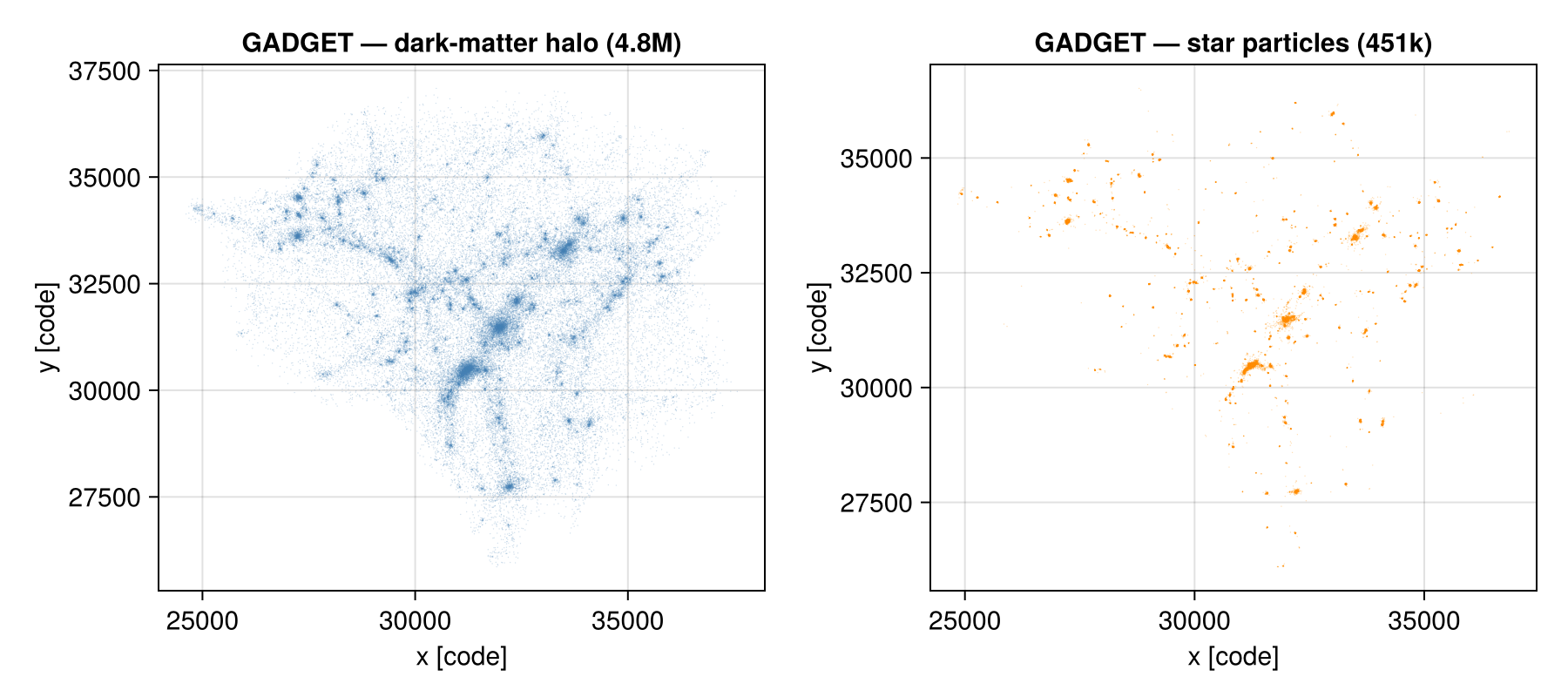
Gas analysis (AREPO / IllustrisTNG)
For gas (PartType0) the cell fields are read alongside the kinematics, so the full thermodynamic analysis runs through the usual getvar/projection calls — in physical units:
info = getinfo(59, "/data/TNG/halo_59")          # IllustrisTNG cutout (AREPO)
gas  = getparticles(info; families=[0])           # PartType0 → :rho,:u,:ne,:metallicity,:sfr,:volume

getvar(gas, :rho, :g_cm3)                          # physical density (a/h applied for cosmological runs)
getvar(gas, :T, :K)                                # temperature [K] from :u (+ :ne when present)
                                                   # (omit the unit and you get code units)
getvar(gas, :metallicity)                          # mass-fraction metallicity

pdf(gas, :rho); profile(gas, :r_sphere, :T)        # PDFs / radial profiles on the gas
Maps come from the particle projection, which deposits each Voronoi cell at its position. Extensive maps (surface density) are mass-conserving to machine precision (Σ pixel·area == msum); intensive maps (temperature, metallicity) take a weighting:
projection(gas, :sd, :Msol_pc2)                          # surface density (mass-conserving)
projection(gas, :T, weighting=:mass)                     # mass-weighted  ⟨T⟩  (dense gas)
projection(gas, :T, weighting=:volume)                   # volume-weighted ⟨T⟩ (diffuse gas)
projection(gas, :sd, :Msol_pc2, weighting=:sph) # SPH-kernel: smear each cell over its footprintAREPO is a Voronoi moving-mesh code — gas lives in irregular polyhedral cells, not on a grid and not as SPH particles. The default deposits each cell at its mesh-generating point (fast, mass-conserving, but it ignores the cell's extent and can speckle in sparse regions). weighting=:sph is the moving-mesh conversion: it smears every cell over an M4 cubic-spline kernel sized from the cell volume (h = α·(3V/4π)^⅓, floored at one pixel), treating each Voronoi cell as an SPH-like blob — the same approach yt uses for AREPO. It resolves each cell's footprint while staying mass-conserving to machine precision (Σ pixel·area == msum for cells inside the field; cells straddling the edge contribute only their in-field share). For a genuinely cell-respecting map, weighting=:voronoi (nearest generator: each line-of-sight sample is assigned to its nearest cell via a KD-tree, capped at the cell's effective radius) gives sharp, piecewise-constant cells — intensive quantities (T, metallicity) are exact (the column ratio cancels cell-volume errors); surface density is approximate (use :sph/:mass for conserving column mass). A fully Voronoi-exact renderer (analytic polyhedron–pixel clipping, as in AREPO's ArepoVTK) would be more faithful still but is rarely needed. Comoving→physical a/h is applied automatically for cosmological snapshots.
(Tip: for a halo cutout in a large box, zoom the projection — center=[…], range_unit=:kpc, xrange=[-R,R], … — and raise res so the window spans enough pixels, since res is full-box-relative.)
Units
GADGET data is in code units (commonly length kpc/h, mass 10¹⁰ M⊙/h, velocity km/s, with h the dimensionless Hubble parameter). The base CGS units are read from the Header (UnitLength/Mass/Velocity_in_*), so getvar(gas, :rho, :g_cm3), getvar(part, :vx, :km_s), etc. return physical quantities out of the box; the unit_length/unit_density/unit_velocity keywords override them. Cosmological metadata (Time = scale factor, Redshift, HubbleParam, Omega0/OmegaLambda) is read from the Header, and a run is treated as cosmological when OmegaLambda > 0. For cosmological runs the comoving→physical factors are applied automatically: positions ∝ a/h, density ∝ h²/a³, mass ∝ 1/h, and velocities carry the √a factor — so a code that returns physical values to getvar needs no manual h/a bookkeeping. (A non-cosmological run, OmegaLambda = 0, is left untouched: a = 1, Time is a physical time.)
How it maps onto Mera's structs
Each PartTypeN group has Coordinates/Velocities (3×N), ParticleIDs, and optionally Masses. The reader concatenates the requested types into one PartDataType with columns (:x,:y,:z, :vx,:vy,:vz, :mass, :id, :family) — positions in code units [0, boxlen], exactly the convention the RAMSES/PLUTO particle readers use, so the particle analysis works unchanged. The mapping is verified data-free in test/60_gadget_reader_tests.jl (a synthesised GADGET file with a MassTable fallback) and on the real GadgetDiskGalaxy sample.
Reference readers
The GADGET HDF5 layout is shared and well-documented; this frontend agrees with the origin tools:
- The GADGET snapshot specification — the
Header+PartType*group format (Coordinates/Velocities/Masses/ParticleIDs,Header/MassTable/BoxSize/…), documented in the GADGET-4 guide and reused by GIZMO, AREPO, SWIFT, EAGLE and IllustrisTNG. - yt — its particle frontends read the same format and select sub-volumes lazily via data objects; Mera's load-time window mirrors that on the particle list. The GadgetDiskGalaxy sample used above comes from the yt sample-data collection.
See also
- Multi-code support — the code-blind architecture and the other readers.
getparticles,getvar,projection— the particle analysis that runs on GADGET data.