Derived Fields & add_field
This page is also an executable Jupyter notebook: open / download derived_fields.ipynb. The notebooks run end-to-end and double as part of Mera's test suite.
Mera computes a large catalogue of derived quantities on demand through getvar, temperature, sound speed, Mach number, cylindrical/spherical velocities, specific angular momentum, Jeans length, kinetic/thermal energy, and many more. You ask for them by name and Mera builds them from the raw stored variables:
# Example-data root. Point this at your own simulation folder, or set the
# MERA_EXAMPLES environment variable; every path below is built from it.
MERA_EXAMPLES = get(ENV, "MERA_EXAMPLES", "/Volumes/FASTStorage/Simulations/Mera-Tests");

using Mera
info = getinfo(300, joinpath(MERA_EXAMPLES, "RAMSES/mw_L10"))
gas  = gethydro(info, verbose=false);
*__ __ _______ ______ _______
| |_| | | _ | | _ |
| | ___| | || | |_| |
| | |___| |_||_| |
| | ___| __ | |
| ||_|| | |___| | | | _ |
|_| |_|_______|___| |_|__| |__|
Mera v1.8.0 | Julia 1.12.7 | 4 threads
[Mera]: 2026-08-31T14:13:55.676
Code: RAMSES
output [300] summary:
mtime: 2023-04-09T05:34:09
ctime: 2025-06-21T18:31:24.020
=======================================================
simulation time: 445.89 [Myr]
boxlen: 48.0 [kpc]
ncpu: 640
ndim: 3
cosmological: false
-------------------------------------------------------
amr: true
level(s): 6 - 10 --> cellsize(s): 750.0 [pc] - 46.88 [pc]
-------------------------------------------------------
hydro: true
hydro-variables: 7 --> (:rho, :vx, :vy, :vz, :p, :scalar_00, :scalar_01)
hydro-descriptor: (:density, :velocity_x, :velocity_y, :velocity_z, :pressure, :scalar_00, :scalar_01)
γ: 1.6667
-------------------------------------------------------
gravity: true
gravity-variables: (:epot, :ax, :ay, :az)
-------------------------------------------------------
particles: true
- Nstars: 5.445150e+05
particle-variables: 7 --> (:vx, :vy, :vz, :mass, :family, :tag, :birth)
particle-descriptor: (:position_x, :position_y, :position_z, :velocity_x, :velocity_y, :velocity_z, :mass, :identity, :levelp, :family, :tag, :birth_time)
-------------------------------------------------------
rt: false
clumps: false
-------------------------------------------------------
namelist-file: ("&COOLING_PARAMS", "&SF_PARAMS", "&AMR_PARAMS", "&BOUNDARY_PARAMS", "&OUTPUT_PARAMS", "&POISSON_PARAMS", "&RUN_PARAMS", "&FEEDBACK_PARAMS", "&HYDRO_PARAMS", "&INIT_PARAMS", "&REFINE_PARAMS")
-------------------------------------------------------
timer-file: true
compilation-file: false
makefile: true
patchfile: true
=======================================================
Processing files: 100%|██████████████████████████████████████████████████| Time: 0:00:19 (29.71 ms/it)
✓ File processing complete! Combining results...These derived names also work everywhere getvar is used internally, in projection, profile, phase, and friends.
For the full set of formulas behind every derived quantity (thermodynamics, velocities, angular momentum, Mach numbers, Jeans/collapse, gravity) and the aggregate statistics (msum, center_of_mass, bulk_velocity, wstat), see How Quantities Are Computed.
Conventions for selected quantities
A few derived quantities carry physical assumptions worth stating explicitly:
- Jeans length
:jeanslengthuses the standard form $λ_J = c_s\,\sqrt{\dfrac{3π}{32\,G\,ρ}}$ (and:jeansmass/:jeansnumberfollow from it). This is one of several Jeans-length conventions in the literature; factors of order unity differ between them. The classical $λ_J = \sqrt{π c^2/(Gρ)}$ is available with the isothermal (:jeanslength_iso, $c^2=P/ρ$) or adiabatic (:jeanslength_ad, $c^2=γP/ρ$) sound speed. The matching cells-per-Jeans-length are:jeansnumber_iso/:jeansnumber_ad, and:jeansnumber_truelovegives Truelove et al.'s (1997) $J = Δx/λ_{J,\mathrm{iso}}$. The_isovariants are what RAMSESjeans_refineuses. - Magnetosonic Mach numbers
:mach_alfven,:mach_fast,:mach_slowrequire the magnetic-field components:bx,:by,:bz(an MHD run) and error otherwise. The B field is taken in RAMSES code units and converted to Gaussian-CGS internally (Alfvén speed $v_A = B/\sqrt{4πρ}$); fast/slow use $v_{f}=\sqrt{c_s^2+v_A^2}$ and the isotropic $v_{s}=c_s v_A/\sqrt{c_s^2+v_A^2}$. All three are dimensionless. (Because they need the field components,getvar_requirementslists:bx,:by,:bz,:rhoamong their dependencies.) - Gravity energy and force
:gravitational_energy,:total_binding_energy,:Fgand the:F…components are mass times a gravity field, so they need the hydro object for the cell mass:getvar(gravity, hydro, :Fg). On gravity alone they raise an error naming the fix. - Cosmological-only quantities,
:overdensity/:delta(hydro) and:age-relatives:formation_time/:formation_redshift/:zform(particles), are defined only for cosmological runs and error on non-cosmological output.
The dependency registry
Each derived quantity knows which raw variables it is built from. That graph is queryable:
println("T [K] range           : ", extrema(getvar(gas, :T, :K)))
println("Mach range            : ", extrema(getvar(gas, :mach)))
println("ekin [erg] (sum)      : ", sum(getvar(gas, :ekin, :erg)))
println("requirements :ekin    : ", getvar_requirements(:hydro, :ekin))
println("requirements [:sd,:T] : ", getvar_requirements(:hydro, [:sd, :T]))
T [K] range : (10.195354771220304, 2.3032126579487386e8)
[Mera] Hint: getvar(:v) has no `vcenter` — velocities are in the BOX frame.
Pass vcenter=:auto for an object with bulk motion (`center=` sets the origin,
`vcenter=` the frame). On a halo streaming at ~200 km/s this shifted |J| by 34 %.
(shown once per session; verbose(false) silences Mera's messages)
Mach range : (0.0015019848658968961, 790.5001832586903)
ekin [erg] (sum) : 3.445146674042365e57
requirements :ekin : [:rho, :vx, :vy, :vz]
requirements [:sd,:T] : [:p, :rho]This is what lets the one-call verbs read only what they need instead of the whole hydro state. project(info, :sd) reads just :rho; project(info, :sd; direction=:edgeon) also pulls the velocities required to orient the disk; quicklook reads only :rho and :p. When a requirement cannot be resolved (e.g. a custom field whose dependency is not stored in that output) the readers safely fall back to reading everything.
Adding your own field: add_field
Register a custom derived field once and it behaves like any built-in quantity, including inside projection and profile.
add_field(:vmag2, (obj, deps) -> deps[:vx].^2 .+ deps[:vy].^2 .+ deps[:vz].^2;
          depends_on = [:vx, :vy, :vz])

println(":vmag2 via getvar     : ", extrema(getvar(gas, :vmag2)))
m = projection(gas, :vmag2; verbose=false)         # works in projection too
println(":vmag2 projection map : ", size(m.maps[:vmag2]))
:vmag2 via getvar : (9.736562820569741e-6, 371.6168616499286)
:vmag2 projection map : (1024, 1024)The compute kernel
compute(dataobject, deps):
dataobject, the data object the field is being evaluated on.deps, aDict{Symbol,Vector}holding the arrays named independs_on, already evaluated with the same centering and masking as the outergetvarcall.- Return the field in code units; Mera applies the requested
unit(or this field's defaultunit) for you.
Dependencies may be raw variables, other built-in derived quantities, or even other user fields, they are resolved recursively:
add_field(:mach_custom, (o, d) -> sqrt.(d[:vx].^2 .+ d[:vy].^2 .+ d[:vz].^2) ./ d[:cs];
          depends_on = [:vx, :vy, :vz, :cs])
println(":mach_custom range    : ", extrema(getvar(gas, :mach_custom)))
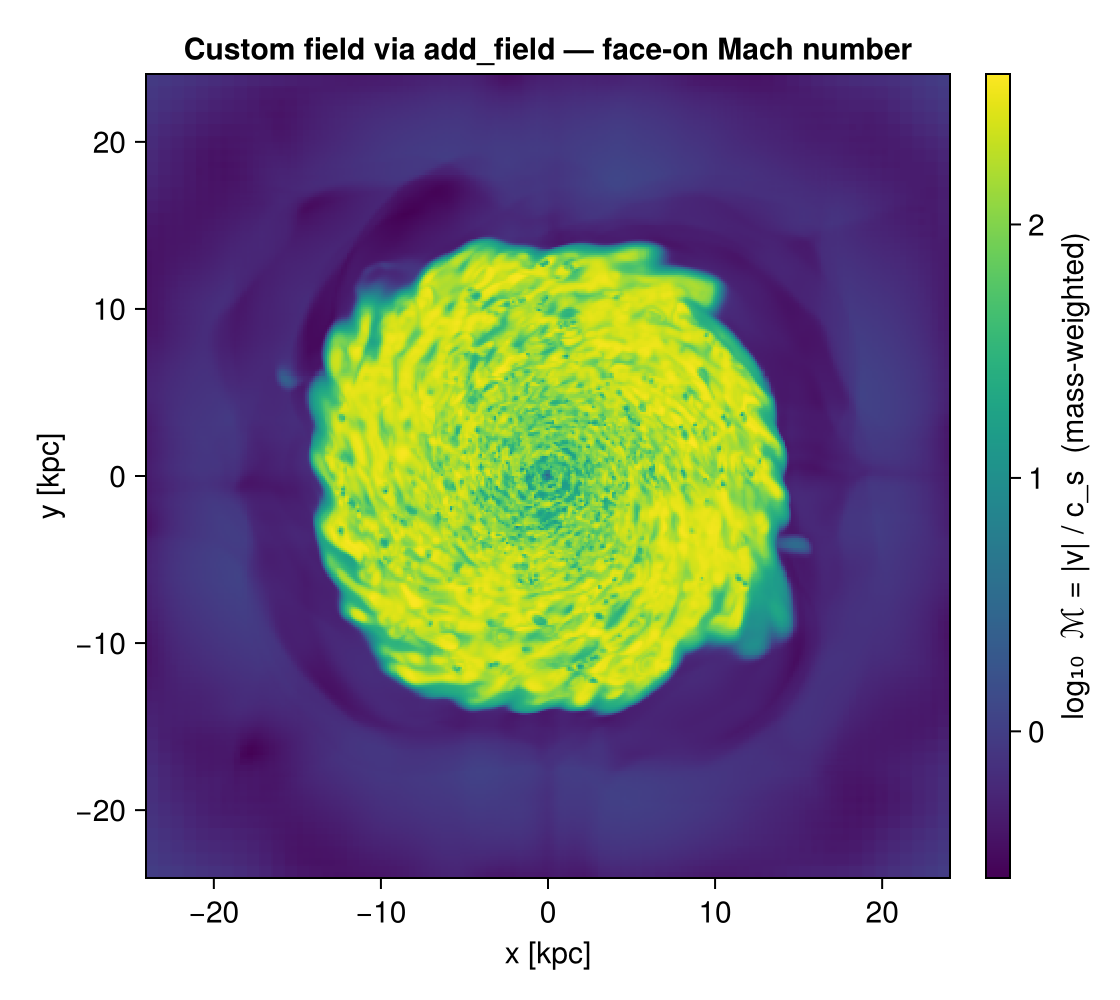
:mach_custom range : (0.0015019848658968961, 790.5001832586903)A registered field is a first-class citizen: it flows through getvar, projection, profile and the rest, with its dependencies read and resolved automatically. For example, once :mach_custom is registered, projection(gas, :mach_custom) just works:
Units
Give a field a default unit (it must be a field of info.scale, or :standard for code units). A unit passed at call time overrides the default:
add_field(:rho_msun_pc3, (o, d) -> d[:rho]; depends_on = [:rho], unit = :Msol_pc3)
getvar(gas, :rho_msun_pc3)               # returns code-unit ρ scaled by info.scale.Msol_pc3
getvar(gas, :rho_msun_pc3, :standard)    # call-time unit override → code units
Other data types
By default fields are registered for hydro. Register for other kinds (or several at once) with datatypes:
add_field(:speed, (o, d) -> sqrt.(d[:vx].^2 .+ d[:vy].^2 .+ d[:vz].^2);
          depends_on = [:vx, :vy, :vz], datatypes = [:hydro, :particle])
Valid kinds: :hydro, :gravity, :rt, :particle, :clump.
Managing registered fields
list_fields(:hydro)                 # names you added for hydro (custom only)
list_fields(:hydro; builtin=true)   # built-in derived fields ∪ your custom ones, sorted
field_info(:vmag2)                  # (; compute, depends_on, unit, description)
delete_field(:vmag2)                # remove it (delete_field(name; datatypes=:all) by default)
list_fields(kind; builtin=true) is the quickest way to discover what you can ask getvar for on a given data type, it returns the dependency-registry built-ins together with any fields you registered. It covers most but not every built-in quantity (a few specialised fields are computed directly in getvar); for the complete human-readable catalogue call getvar() with no arguments.
The default (builtin=false) lists only the fields you registered, so it starts empty and grows as you add_field (and shrinks again on delete_field):
list_fields(:hydro) # builtin=false (default): custom fields only — none yetSymbol[]add_field(:speed2, (o, d) -> d[:vx].^2 .+ d[:vy].^2 .+ d[:vz].^2; depends_on=[:vx, :vy, :vz])
list_fields(:hydro) # the field you just added now appears1-element Vector{Symbol}:
:speed2delete_field(:speed2)
list_fields(:hydro) # removed again → back to emptySymbol[]With builtin=true the same call instead returns the full catalogue. The lists below are generated live from the registry at doc-build time, so they always match the installed version. Hydro:
list_fields(:hydro; builtin=true)78-element Vector{Symbol}:
:T
:T_rt
:Temp
:Temperature
:beta
:bmag
:bx
:by
:bz
:cellsize
⋮
:vz2
:vθ_sphere
:vϕ_cylinder
:vϕ_cylinder2
:vϕ_sphere
:x
:y
:z
:ϕGravity, RT, particle, clump (same call, different kind):
list_fields(:gravity; builtin=true)15-element Vector{Symbol}:
:a_magnitude
:ar_cylinder
:ar_sphere
:aθ_sphere
:aϕ_cylinder
:aϕ_sphere
:cellsize
:r_cylinder
:r_sphere
:specific_gravitational_energy
:volume
:x
:y
:z
:ϕlist_fields(:particle; builtin=true)48-element Vector{Symbol}:
:T
:Temp
:Temperature
:age
:beta
:bmag
:cellsize
:cs
:e_magnetic
:ekin
⋮
:vr_sphere
:vx2
:vy2
:vz2
:vθ_sphere
:vϕ_cylinder
:vϕ_sphere
:zform
:ϕ(rt = list_fields(:rt; builtin=true), clump = list_fields(:clump; builtin=true))(rt = [:cellsize, :r_cylinder, :r_sphere, :volume, :x, :y, :z, :ϕ], clump = [:ekin, :mass, :v, :x, :y, :z])Registered fields live for the current Julia session (they are not persisted to disk). Put your add_field calls in a startup script or at the top of your analysis to make them available every run.
Registered fields also work as quantities in First-Look Reports cards, the report reads only the dependencies your field declares.
Custom units
A field's unit can be an existing info.scale field, :standard, a plain number (a literal code→display factor), or a custom unit you register with add_unit. Registered units work everywhere a unit is accepted, including getvar(obj, var, unit) for built-in quantities:
add_unit(:Msun_per_century, 1e-2)               # 1 code-unit value × 1e-2
add_field(:mdot, (o,d) -> d[:rho]; depends_on=[:rho], unit=:Msun_per_century)
getvar(gas, :mass, :Msun_per_century)           # also applies to built-in fields
list_units();  delete_unit(:Msun_per_century)
Inspecting dependencies
field_dependencies(:hydro, :ekin)   # (; direct=[:mass,:v], raw=[:rho,:vx,:vy,:vz])
field_tree(:hydro, :mach)           # prints the dependency tree down to raw leaves
mach
├─ v
│ ├─ vx (raw)
│ ├─ vy (raw)
│ └─ vz (raw)
└─ cs
├─ p (raw)
└─ rho (raw)See also
Registered fields are used throughout Mera: getvar computes them, projection and profile read only the dependencies they need (via getvar_requirements), and the First Look (quicklook / report) verbs benefit from the same needs-based reading. See also Star-Formation Rate and Clump Finding for fields used in analysis.
API
Mera.add_field — Function
add_field(name::Symbol, compute::Function; depends_on=Symbol[], datatypes=:hydro,
          unit::Symbol=:standard, description::String="")
Register a user-defined derived field that then behaves like any built-in getvar quantity — it works in getvar, and therefore in projection, profile, phase, etc.
compute(dataobject, deps)— your kernel.depsis aDict{Symbol,Vector}holding the arrays ofdepends_on(already centered / masked consistently). Return the field in code units; the requestedunit(or this field's defaultunit) is applied for you.depends_on— the variables your kernel needs (built-in or other user fields). These are also recorded in the dependency graph sogetvar_requirements(and the read-only-what-you-need logic inproject/quicklook) cover your field.datatypes— a kind symbol or collection of them::hydro,:gravity,:rt,:particle,:clump.unit— default unit symbol (must be a field ofinfo.scale, or:standard).
add_field(:vmag2, (o, d) -> d[:vx].^2 .+ d[:vy].^2 .+ d[:vz].^2; depends_on=[:vx,:vy,:vz])
getvar(gas, :vmag2)
projection(gas, :vmag2)
See also delete_field, list_fields.
Mera.delete_field — Function
delete_field(name::Symbol; datatypes=:all)Remove a previously add_field-registered field. datatypes=:all (default) removes it from every kind; otherwise pass a kind symbol or collection.
Mera.list_fields — Function
list_fields(kind::Symbol=:hydro; builtin::Bool=false) -> Vector{Symbol}The registered derived-field names for a data-type kind (:hydro, :gravity, :rt, :particle, :clump), sorted.
By default only the user-added fields (registered with add_field) are returned — this is the back-compatible behaviour. With builtin=true the result also includes the built-in derived quantities known to the dependency registry (FIELD_DEPS[kind]), so you get a single combined list of everything resolvable for that kind:
list_fields(:hydro)                 # only the fields you added
list_fields(:hydro; builtin=true)   # built-in registry fields ∪ your custom fields
Note: builtin=true reflects the dependency registry, which covers most but not every built-in quantity (a few specialised fields, e.g. some RT-ionization variables, are computed directly in getvar without a registry entry). For the full human-readable catalogue call getvar() with no arguments.
list_fields(data; io=stdout) -> Vector{NamedTuple}Which derived fields are available for this loaded object, and — where it matters — which variant of a field would actually run. Unlike list_fields(:particles), which answers for a data kind, this answers for the columns you actually read.
Each entry is (name, available, missing, using_optional, note):
available— every required column is present, sogetvar(data, name)will work;missing— the required columns that are absent (empty whenavailable);using_optional— optional columns that ARE loaded and will therefore be used;note— the variant description, when the field has one.
This exists because a field's value can depend on what was loaded, not only on the snapshot. getvar(gas, :T) takes μ from :ne when present and falls back to a neutral-primordial μ ≈ 1.22 otherwise — up to a factor ~2 apart for ionised gas — so the same call on the same snapshot gives different temperatures depending on the vars= used at load time. This is the only place that says so.
gas = getparticles(info; families=[0], vars=[:rho, :u])        # no :ne
for f in list_fields(gas)
    f.name === :T && println(f.note, "   using: ", f.using_optional)
end
# → "μ from :ne when it was loaded; neutral-primordial μ≈1.22 otherwise"   using: Symbol[]
See also getvar_requirements, getvar_optional, field_info.
Mera.field_info — Function
field_info(name::Symbol; kind::Symbol=:hydro)The registration record (; compute, depends_on, unit, description) for a user field, or nothing if it isn't registered for that kind.
Mera.field_dependencies — Function
field_dependencies(kind::Symbol, var::Symbol) -> (; direct, raw)Inspect a derived field's dependencies for data-type kind: direct are its immediate dependencies (raw or derived, as declared), raw is the transitive set of physical stored variables it ultimately needs (same as getvar_requirements). Works for built-in and add_field-registered quantities.
Mera.field_tree — Function
field_tree(kind::Symbol, var::Symbol; io=stdout)Pretty-print the dependency tree of a derived field down to its raw leaves (cycle-safe).
Mera.add_unit — Function
add_unit(name::Symbol, factor::Real)Register a custom unit: a value in code units is multiplied by factor to convert to this unit. The name then works anywhere a unit symbol is accepted — in add_field (as the field's default unit), and in getvar(obj, var, name).
add_unit(:Msun_per_yr, 1.0)                      # e.g. for an SFR-like custom field
add_field(:mdot, (o,d)->d[:rho]; depends_on=[:rho], unit=:Msun_per_yr)
See also delete_unit, list_units.
Mera.delete_unit — Function
delete_unit(name::Symbol)Remove a custom unit registered with add_unit.
Mera.list_units — Function
list_units() -> Vector{Symbol}The custom unit names registered with add_unit.
Mera.getvar_requirements — Function
getvar_requirements(kind::Symbol, vars) -> Vector{Symbol}The sorted set of physical stored variables that must be read to compute vars (a Symbol or a collection), with always-present geometry leaves (:cx/:cy/:cz, :level, :x/:y/:z, :cellsize, :volume, …) removed. Unknown/custom symbols are returned as-is (callers can detect these and fall back to reading everything).
getvar_requirements(:hydro, :ekin)        # [:rho, :vx, :vy, :vz]
getvar_requirements(:hydro, [:sd, :T])    # [:rho, :p]   (:sd is an alias of surface density → :rho)