Clump Finding
This page is also an executable Jupyter notebook: open / download clumpfind.ipynb. The notebooks run end-to-end and double as part of Mera's test suite.
clumpfind locates connected over-dense structures and returns a per-clump catalog. It works two ways:
- 3D, friends-of-friends on the cells (hydro) or particles above a field threshold.
- 2D, connected-component labelling of a
projectionmap above a threshold.
Both return a ClumpCatalog sorted most-massive-first.
The synthetic, data-free example builds a Mera object whose clumps are known exactly and scores every finder and feature against it (downloadable dataset included), the quickest way to see the behaviour and accuracy of each algorithm.
The 3D finder runs on a pluggable framework: an AbstractFinder value (one of seven, ThresholdFoF, DensityWatershed, Dendrogram, GraphSegFinder, HDBSCANFinder, PhaseSpaceFoF, PersistenceFinder) selects the algorithm, while a shared neighbour index, statistics, boundedness and catalog pipeline serves them all. The keyword form clumpfind(obj, field; …) shown throughout this page is a convenience shim that builds a ThresholdFoF for you, so existing scripts are unchanged; pass a finder explicitly to pick the algorithm:
cat   = clumpfind(gas, ThresholdFoF(:rho; threshold=1e2, threshold_unit=:nH, linking_length=0.2))
cores = clumpfind(gas, DensityWatershed(:rho; threshold=1e2, threshold_unit=:nH, linking_length=0.4))
Choosing a finder
Seven AbstractFinder algorithms plug into the same neighbour-index / statistics / boundedness / catalog pipeline, so they share keywords and outputs and differ only in how cells are grouped. Start with ThresholdFoF; reach for the others when its single threshold isn't enough.
| Finder | Method | Reach for it when |
|---|---|---|
ThresholdFoF | Friends-of-friends above a field threshold (Davis et al. 1985) | The default, fast, robust; isolated clumps over a clear background |
DensityWatershed | FoF connectivity, then watershed split at saddles (DENMAX/SUBFIND); persistence prunes shallow basins | Deblending touching/overlapping peaks inside one connected over-dense region |
Dendrogram | Multi-scale hierarchy (Rosolowsky & Leroy 2008); min_delta peak-to-saddle contrast | You want the nested hierarchy (leaves → branches → roots), not a flat catalog |
GraphSegFinder | Graph segmentation by internal-vs-boundary contrast (Felzenszwalb & Huttenlocher 2004) | Density varies smoothly and no single threshold separates structures |
HDBSCANFinder | Density-based hierarchical clustering, stable-cluster extraction | Clumps span a wide density range / variable background; you'd rather not pick a threshold |
PhaseSpaceFoF | 6-D position+velocity FoF (Rockstar-style; Behroozi et al. 2013) | Kinematically separating spatially-overlapping structures (streams, mergers, substructure) |
PersistenceFinder | Topological persistence / ToMATo (Chazal et al. 2013) | Crowded fields, rank peaks by prominence, robust to noise |
All take the same shared keywords (field, threshold, linking_length, backend, gravitational boundedness, tidal truncation, …); see the Density-adaptive finders and Phase-space & topology sections below for the algorithm-specific parameters.
massfunctionplot draws the clump mass function straight from a ClumpCatalog, cumulative or differential, with a Makie backend loaded:
using CairoMakie
massfunctionplot(cat; cumulative=true)
3D, cells or particles (friends-of-friends)
Cells/particles with field ≥ threshold are linked into a clump when they lie within linking_length (in pos_unit) of one another:
# Example-data root. Point this at your own simulation folder, or set the
# MERA_EXAMPLES environment variable; every path below is built from it.
MERA_EXAMPLES = get(ENV, "MERA_EXAMPLES", "/Volumes/FASTStorage/Simulations/Mera-Tests");

using Mera
info = getinfo(400, joinpath(MERA_EXAMPLES, "RAMSES/manu_sim_sf_L14"))
# cap the refinement (lmax=10) and load only the central box, so the finders run in seconds
gas  = gethydro(info; lmax=10, xrange=[-5,5], yrange=[-5,5], zrange=[-5,5],
                center=[:bc], range_unit=:kpc);
println("cells loaded : ", length(gas.data))
println("box length   : ", gas.boxlen, " kpc")
*__ __ _______ ______ _______
| |_| | | _ | | _ |
| | ___| | || | |_| |
| | |___| |_||_| |
| | ___| __ | |
| ||_|| | |___| | | | _ |
|_| |_|_______|___| |_|__| |__|
Mera v1.8.0 | Julia 1.12.7 | 4 threads
[Mera]: 2026-08-31T14:10:25.291
Code: RAMSES
output [400] summary:
mtime: 2018-09-05T09:51:55
ctime: 2025-06-29T20:06:45.267
=======================================================
simulation time: 594.98 [Myr]
boxlen: 48.0 [kpc]
ncpu: 2048
ndim: 3
cosmological: false
-------------------------------------------------------
amr: true
level(s): 6 - 14 --> cellsize(s): 750.0 [pc] - 2.93 [pc]
-------------------------------------------------------
hydro: true
hydro-variables: 7 --> (:rho, :vx, :vy, :vz, :p, :passive_scalar_1, :passive_scalar_2)
hydro-descriptor: (:density, :velocity_x, :velocity_y, :velocity_z, :thermal_pressure, :passive_scalar_1, :passive_scalar_2)
γ: 1.6667
-------------------------------------------------------
gravity: true
gravity-variables: (:epot, :ax, :ay, :az)
-------------------------------------------------------
particles: true
- Npart: 5.091500e+05
- Nstars: 5.066030e+05
- Ndm: 2.547000e+03
particle-variables: 5 --> (:vx, :vy, :vz, :mass, :birth)
-------------------------------------------------------
rt: false
-------------------------------------------------------
clumps: true
clump-variables: (:index, :lev, :parent, :ncell, :peak_x, :peak_y, :peak_z, Symbol("rho-"), Symbol("rho+"), :rho_av, :mass_cl, :relevance)
-------------------------------------------------------
namelist-file: false
timer-file: false
compilation-file: true
makefile: true
patchfile: true
=======================================================
[Mera]: Get hydro data: 2026-08-31T14:10:27.716
Key vars=(:level, :cx, :cy, :cz)
Using var(s)=(1, 2, 3, 4, 5, 6, 7) = (:rho, :vx, :vy, :vz, :p, :passive_scalar_1, :passive_scalar_2)
center: [0.5, 0.5, 0.5] ==> [24.0 [kpc] :: 24.0 [kpc] :: 24.0 [kpc]]
domain:
xmin::xmax: 0.3958333 :: 0.6041667 ==> 19.0 [kpc] :: 29.0 [kpc]
ymin::ymax: 0.3958333 :: 0.6041667 ==> 19.0 [kpc] :: 29.0 [kpc]
zmin::zmax: 0.3958333 :: 0.6041667 ==> 19.0 [kpc] :: 29.0 [kpc]
📊 Processing Configuration:
Total CPU files available: 2048
Files to be processed: 1939
Compute threads: 4
GC threads: 4
📍 Spatial filtering active: 109 files skipped
Processing files: 100%|██████████████████████████████████████████████████| Time: 0:00:26 (13.47 ms/it)
✓ File processing complete! Combining results...
✓ Data combination complete!
Final data size: 1277874 cells, 7 variables
Creating Table from 1277874 cells with max 4 threads...
Threading: 4 threads for 11 columns
Max threads requested: 4
Available threads: 4
Using parallel processing with 4 threads
Creating IndexedTable with 11 columns...
✓ Table created in 2.387 seconds
Memory used for data table :107.2445936203003 MB
-------------------------------------------------------
cells loaded : 1277874
box length : 48.0 kpcSelect cells above 100 cm⁻³, link within 0.2 kpc, and keep clumps with ≥ 5 cells:
cat = clumpfind(gas, :rho;
                threshold=1e2, threshold_unit=:nH,   # select cells above 100 cm^-3
                linking_length=0.2, pos_unit=:kpc,    # link within 0.2 kpc
                mass_unit=:Msol, min_members=5)       # keep clumps with >= 5 cells

println("number of clumps : ", length(cat))
println()
println(cat)                       # ClumpCatalog summary
number of clumps : 34
ClumpCatalog: 34 clumps [3D, field=rho ≥ 100.0 nH]
mass Msol: total 6.712e9 max 2.034e9 median 4.058e7
largest: 487 members, mass 2.034e9# the most massive clump is a NamedTuple
c1 = cat[1]
println("largest clump:")
@show c1.id
@show c1.n_members
@show c1.mass
@show c1.com
@show c1.peak
@show c1.radiuslargest clump:
c1.id = 1
c1.n_members = 487
c1.mass = 2.0337645080962305e9
c1.com = (22.061102887532154, 24.038745759498653, 24.05425590948421)
c1.peak = 86745.10109055592
c1.radius = 0.92292580203689070.9229258020368907With a Makie backend loaded, clumpplot draws the catalog directly, each clump's centre of mass as a marker sized by mass (and coloured by log mass), optionally over a projection background:
using CairoMakie
bg  = projection(gas, :sd, :Msol_pc2; center=[:bc])
fig = clumpplot(cat; background=bg) # marker size ∝ mass, colour = log₁₀ mass: marker size ∝ mass, colour = log₁₀ mass) overlaid on the gas surface density Σ. The markers sit on the over-dense peaks above the density threshold; fainter arm and inter-arm gas *below* the threshold is intentionally not flagged, clump finding is always threshold- (and finder-) dependent.](../assets/features/clump_catalog.png)
A clump is what the finder + threshold define. Two effects are worth knowing:
- Threshold selection. Peaks fainter than
thresholdare not selected at all, and a single friends-of-friends threshold can merge a whole connected over-dense region (e.g. the dense disk) into one clump while leaving fainter arms out. To separate touching peaks, useDensityWatershed(split at saddles, withpersistenceto prune shallow basins) rather than a higherThresholdFoFthreshold. - Boundedness. Detected over-densities are not necessarily self-gravitating. Add
boundedness=trueto get each clump's virial ratioalpha_vir = 2·e_kin/|e_grav|and aboundflag, andbound_only=trueto keep only self-bound clumps. (On a coarse box, many "clumps" are turbulence-supported,alpha_vir ≫ 1, and would be dropped bybound_only.)
Makie also exports a Dendrogram type, so when both are loaded (using Mera, CairoMakie) a bare Dendrogram(...) is ambiguous, qualify Mera's finder as Mera.Dendrogram(...) in that case. The other six finders have unique names.
Choosing a finder explicitly
The keyword form builds a ThresholdFoF for you; pass a finder value to pick the algorithm. For watershed deblending, a DensityWatershed finder additionally accepts persistence (in field units): a basin whose prominence (peak − saddle) is below persistence is merged into the deeper basin it meets, suppressing over-segmentation of shallow saddles (Rosolowsky & Leroy 2008 min_delta):
fof   = clumpfind(gas, ThresholdFoF(:rho; threshold=1e2, threshold_unit=:nH, linking_length=0.4))
cores = clumpfind(gas, DensityWatershed(:rho; threshold=1e2, threshold_unit=:nH,
                                        linking_length=0.4, persistence=0.3))

println("ThresholdFoF     : ", length(fof),   " clumps")
println("DensityWatershed : ", length(cores), " clumps (saddle-split)")
ThresholdFoF : 43 clumps
DensityWatershed : 45 clumps (saddle-split)Gravitational boundedness
boundedness=true adds per-clump energetics (cgs) and keeps, optionally, only self-bound structures:
catb = clumpfind(gas, :rho; threshold=1e2, threshold_unit=:nH, linking_length=0.2,
                 min_members=5, boundedness=true, egrav=:tree)

b1 = catb[1]
@show b1.alpha_vir        # virial parameter 2*E_kin/|E_grav|
@show b1.bound            # E_kin + E_therm < |E_grav| ?
@show b1.e_grav
b1.alpha_vir = 1.373366071452284
b1.bound = true
b1.e_grav = 7.214955930128814e567.214955930128814e56Each clump gains e_kin (COM-frame kinetic), e_therm (thermal, gas), e_grav (binding energy), alpha_vir, and bound. The potential is chosen with egrav: :approx (⅗·GM²/R, fast but biased) by default, :direct (exact pairwise sum up to direct_max members), or :tree (Barnes to Hut octree, O(N log N), accurate at any N). softening (in pos_unit) softens the kernel as 1/√(r²+ε²).
iterative_unbinding=true adds SUBFIND-style unbinding: members with positive total energy in the bulk-velocity frame are stripped iteratively, so each clump's reported mass/membership is its self-bound subset.
cat = clumpfind(gas, :rho; threshold=1e2, threshold_unit=:nH, linking_length=0.2,
                boundedness=true, egrav=:tree, iterative_unbinding=true)
Validators, a composable acceptance chain
Instead of the boundedness keywords, pass a validators chain of value-typed criteria that a clump must all satisfy (an AND): MinMembers, Bound (configures the boundedness pass, potential egrav, iterative unbinding, and keeps only self-bound clumps), VirialBelow, MassAbove, and Custom (an arbitrary clump -> Bool predicate). Membership-mutating validators (Bound with unbinding) act during the analysis; predicates filter the catalog afterwards, regardless of the order listed. A non-empty validators overrides the boundedness/bound_only/min_members/egrav/iterative_unbinding keywords.
big = clumpfind(gas, ThresholdFoF(:rho; threshold=1e2, threshold_unit=:nH, linking_length=0.2);
                validators=[MinMembers(10), Custom(c -> c.mass > 1e4)])
println("clumps passing the validator chain: ", length(big))
clumps passing the validator chain: 22# ≥20 members, tree-gravity self-bound (iterative unbinding), and virially bound:
cores = clumpfind(gas, DensityWatershed(:rho; threshold=1e2, threshold_unit=:nH, linking_length=0.4);
validators=[MinMembers(20), Bound(:tree; iterative=true), VirialBelow(2.0)])Particles, cluster-finding on stars
The same call works on particles (e.g. cluster-finding on stars):
stars = getparticles(info; xrange=[-5,5], yrange=[-5,5], zrange=[-5,5],
                     center=[:bc], range_unit=:kpc);
cats  = clumpfind(stars, :mass; threshold=0.0, linking_length=0.5, min_members=10)
println("stellar groups found : ", length(cats))
println(cats)
[Mera]: Get particle data: 2026-08-31T14:11:14.264
Using threaded processing with 4 threads
Key vars=(:level, :x, :y, :z, :id)
Using var(s)=(1, 2, 3, 4, 5) = (:vx, :vy, :vz, :mass, :birth)
center: [0.5, 0.5, 0.5] ==> [24.0 [kpc] :: 24.0 [kpc] :: 24.0 [kpc]]
domain:
xmin::xmax: 0.3958333 :: 0.6041667 ==> 19.0 [kpc] :: 29.0 [kpc]
ymin::ymax: 0.3958333 :: 0.6041667 ==> 19.0 [kpc] :: 29.0 [kpc]
zmin::zmax: 0.3958333 :: 0.6041667 ==> 19.0 [kpc] :: 29.0 [kpc]
Processing 1939 CPU files using 4 threads
Mode: Threaded processing
Combining results from 4 thread(s)...
Found 2.624670e+05 particles
Memory used for data table :18.02324104309082 MB
-------------------------------------------------------
stellar groups found : 1
ClumpCatalog: 1 clumps [3D, field=mass ≥ 0.0 standard]
mass Msol: total 2.986e9 max 2.986e9 median 2.986e9
largest: 262102 members, mass 2.986e9Choosing parameters. linking_length should be a few times the local resolution, comparable to or larger than the finest cell size (3D AMR) or the mean interparticle separation (particles); too small and dense regions fragment, too large and separate clumps merge. threshold sets which material is considered (e.g. a number-density floor for the cold/dense gas). min_members drops noise-sized detections; mask restricts the search to a pre-selected subset.
Deblending overlapping clumps
A single threshold merges touching structures into one friends-of-friends group. deblend splits each group at its density peaks (peaks separated by peak_min_distance in pos_unit):
cat = clumpfind(gas, :rho; threshold=1e2, threshold_unit=:nH, linking_length=0.4,
                deblend=:peak, peak_min_distance=0.3)        # nearest-peak (also `deblend=true`)
cat = clumpfind(gas, :rho; threshold=1e2, threshold_unit=:nH, linking_length=0.4,
                deblend=:watershed)                          # density-descending basins (respects saddles)
:peak assigns each member to the nearest peak; :watershed floods the density field from each peak downhill (DENMAX/SUBFIND-style for points, Meyer flooding for 2-D maps), which follows saddles better. Both are mass-conserving (every member/pixel lands in exactly one clump).
Bound-substructure trees
substructure=true builds a two-level tree: each top-level clump is split into density basins (watershed) and the gravitationally self-bound ones (≥ sub_min_members) are attached as nested subclumps. Top clumps gain the boundedness fields too. tidal=true additionally strips each subclump's members beyond its Jacobi radius r_t = D·(m_sub/3·M_host(<D))^{1/3} relative to the host (parent) clump (King 1962; Binney & Tremaine 2008).
cat = clumpfind(gas, :rho; threshold=1e2, threshold_unit=:nH, linking_length=0.4, substructure=true)
cat[1].n_subclumps          # number of self-bound subclumps inside the most massive clump
cat[1].subclumps[1].mass    # the largest bound subclump's mass
tidal=:tensor uses the tidal-tensor / Hill radius instead of the Jacobi form: it fits the local gravity acceleration field a(x) (from a gravity object, getgravity) around each subclump to the tidal tensor T_ij = −∂²Φ/∂x_i∂x_j and truncates at r_t³ = G·m_sub / λ_max(T), exactly the Hill radius R·(m_sub/2M)^{1/3} for a point-mass host. tidal_sample (default 3) sets the fit radius in units of the subclump radius.
grav = getgravity(getinfo(output, path))
cat  = clumpfind(gas, :rho; threshold=1e2, threshold_unit=:nH, linking_length=0.4,
                 substructure=true, tidal=:tensor, gravity=grav)
Multi-field, gas + stars + dark matter together
Pass a vector of components to find over-densities across several mass species in one pass. Each component pre-selects its points (with its own field/threshold and an optional mask); the catalog reports a per-component mass/count breakdown per clump:
cat = clumpfind([
    (obj=gas,   field=:rho,  threshold=1e2, threshold_unit=:nH, name=:gas),
    (obj=parts, field=:mass, threshold=0.0, name=:stars, mask = o -> getvar(o,:birth) .> 0),
    (obj=parts, field=:mass, threshold=0.0, name=:dm,    mask = o -> getvar(o,:birth) .<= 0),
]; linking_length=0.5)

cat[1].mass                  # total mass of the largest structure
cat[1].components.gas.mass   # …split by component
cat[1].components.dm.n       # dark-matter particle count
Pass boundedness=true to get the combined-cloud energetics (e_kin, e_therm, e_mag, e_grav, alpha_vir, bound) summed over all species, the self-gravity test uses gas + stars + DM together while the components breakdown stays the per-species mass budget (egrav, softening, iterative_unbinding, bound_only work as in the single-object form).
The catalog
Each entry is a NamedTuple; the fields differ slightly between 3D and 2D:
| field | meaning |
|---|---|
id | rank (1 = most massive) |
n_members | cells / particles (3D) or pixels (2D) |
mass | clump mass (3D) or area-integral (2D) |
com | centre of mass, (x,y,z) (3D) or (x,y) (2D) |
peak, peak_pos | maximum field value and its position |
radius | maximum member distance from the COM |
ClumpCatalog behaves like a vector (length, cat[i], iteration). For analysis/export, get a columnar table (a NamedTuple of vectors, including boundedness and per-component columns when present), ready for DataFrame / CSV.write:
masses = [c.mass for c in cat]
println("mass range [Msol] : ", extrema(masses))

tbl = clumptable(cat)
println("table columns     : ", keys(tbl))
println("search meta       : ", cat.meta)
mass range [Msol] : (2.306207938000301e6, 2.0337645080962305e9)
table columns : (:id, :n_members, :mass, :com_x, :com_y, :com_z, :radius, :peak)
search meta : (dim = Symbol("3D"), field = :rho, threshold = 100.0, threshold_unit = :nH, linking_length = 0.2, pos_unit = :kpc, mass_unit = :Msol, n_selected = 1889, boundedness = false, deblend = false, substructure = false, unbinding = false, hierarchy = false, finder = :ThresholdFoF)See also getclumps to load a RAMSES-produced clump catalog instead of finding clumps yourself, and Off-axis Projection for tilted maps to segment in 2D.
Mass function & report integration
m, Ngt = clump_massfunction(cat; cumulative=true)
println("cumulative mass-function bins : ", length(m))
println("N(>= M_min)                   : ", first(Ngt))
cumulative mass-function bins : 34
N(>= M_min) : 34using CairoMakie
bg = projection(gas, :sd, :Msol_pc2; center=[:bc])
fig = Figure(size=(950, 420))
ax1 = Axis(fig[1,1]; title="Clumps over surface density", aspect=DataAspect())
hidedecorations!(ax1)
heatmap!(ax1, log10.(bg.maps[:sd]'); colormap=:inferno)
coms = [c.com for c in cat]
scatter!(ax1, [c[1] for c in coms], [c[2] for c in coms];
color=:cyan, markersize=6, strokewidth=0.5, strokecolor=:black)
ax2 = Axis(fig[1,2]; title="Cumulative clump mass function",
xlabel="mass [Msol]", ylabel="N(>= M)", xscale=log10, yscale=log10)
scatterlines!(ax2, m, Ngt)
fig[Mera]: 2026-08-31T14:11:43.099
center: [0.5, 0.5, 0.5] ==> [24.0 [kpc] :: 24.0 [kpc] :: 24.0 [kpc]]
domain:
xmin::xmax: 0.3958333 :: 0.6041667 ==> 19.0 [kpc] :: 29.0 [kpc]
ymin::ymax: 0.3958333 :: 0.6041667 ==> 19.0 [kpc] :: 29.0 [kpc]
zmin::zmax: 0.3958333 :: 0.6041667 ==> 19.0 [kpc] :: 29.0 [kpc]
Selected var(s)=(:sd,)
Weighting = :mass
Effective resolution: 1024^2
Map size: 214 x 214
Pixel size: 46.875 [pc]
Simulation min.: 46.875 [pc]
Available threads: 4
Requested max_threads: 4
Variables: 1 (sd)
Processing mode: Sequential (single thread)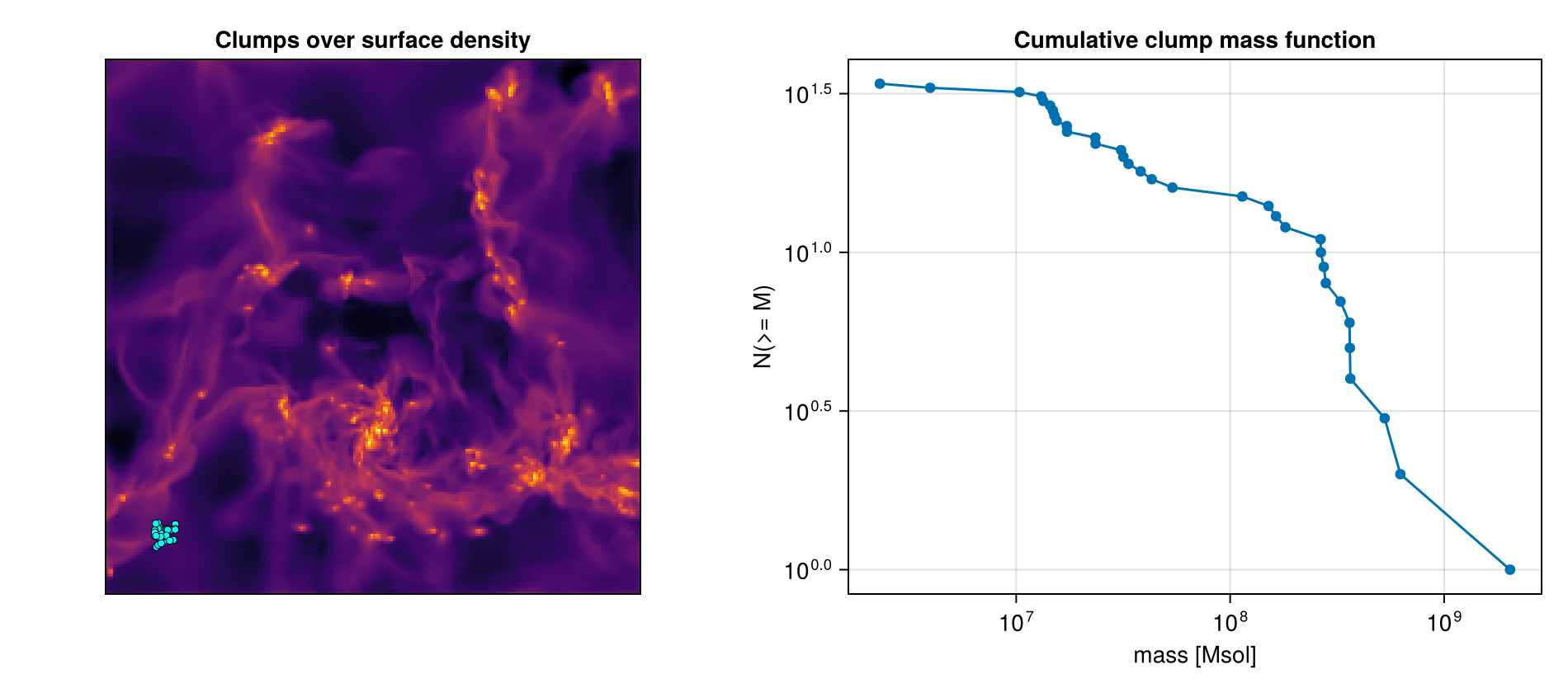
A ClumpCard runs clumpfind inside a First-Look Report (the full catalog is kept in the card's data.catalog):
report(output; path, cards=[ ClumpCard(:hydro, :rho; threshold=1e2, threshold_unit=:nH,
                                       linking_length=0.2) ])
2D, a projection map (connected components)
Run it on any projection result to segment a map above a threshold:
sd2  = projection(gas, :sd, :Msol_pc2; pxsize=[0.1, :kpc], center=[:bc])
cat2 = clumpfind(sd2, :sd; threshold=50.0, connectivity=8)   # regions >= 50 Msol/pc^2
println("2D regions found : ", length(cat2))
length(cat2) > 0 && println("largest region   : ", cat2[1].n_members, " pixels, mass ",
                            round(cat2[1].mass, sigdigits=4))
[Mera]: 2026-08-31T14:11:57.574
center: [0.5, 0.5, 0.5] ==> [24.0 [kpc] :: 24.0 [kpc] :: 24.0 [kpc]]
domain:
xmin::xmax: 0.3958333 :: 0.6041667 ==> 19.0 [kpc] :: 29.0 [kpc]
ymin::ymax: 0.3958333 :: 0.6041667 ==> 19.0 [kpc] :: 29.0 [kpc]
zmin::zmax: 0.3958333 :: 0.6041667 ==> 19.0 [kpc] :: 29.0 [kpc]
Selected var(s)=(:sd,)
Weighting = :mass
Effective resolution: 481^2
Map size: 101 x 101
Pixel size: 99.792 [pc]
Simulation min.: 46.875 [pc]
Available threads: 4
Requested max_threads: 4
Variables: 1 (sd)
Processing mode: Sequential (single thread)
2D regions found : 26
largest region : 1178 pixels, mass 5962.0connectivity is 8 (diagonals count) or 4. For a surface-density map each region's mass is the exact area-integral Σ value · pixel_area; positions are in the map's extent units.
Multi-scale hierarchy (dendrogram)
A Dendrogram finder returns the finest density peaks (local maxima with prominence ≥ min_delta) as the catalog's leaf clumps; passing hierarchy=true additionally attaches the full merge StructureTree, the level at which leaves join into branches and ultimately roots (Rosolowsky & Leroy 2008):
cat  = clumpfind(gas, Dendrogram(:rho; threshold=1e2, threshold_unit=:nH,
                                 linking_length=0.5, min_delta=0.3); hierarchy=true)
tree = cat.tree
length(Mera.leaves(tree))               # finest structures (= the catalog clumps)
r = Mera.roots(tree)[1]                  # a top-level structure
Mera.children(tree, r)                   # its immediate sub-structures
r.n_subtree                              # members in the whole subtree
Density-adaptive finders
Two further finders handle variable-density fields without a single hard threshold:
HDBSCANFinder, a self-contained HDBSCAN\* (Campello+2013; McInnes+2017): core distances define a mutual-reachability metric whose MST is condensed into a cluster hierarchy, and the most stable clusters (≥min_cluster_size) are extracted. Near parameter-free; points outside any stable cluster are labelled noise (dropped).GraphSegFinder, Felzenszwalb & Huttenlocher (2004) graph segmentation: keeps within-region density variation below the between-region contrast, with a singlescaleknob. Near-linear; a fast multi-scale deblender.
cat = clumpfind(gas, HDBSCANFinder(:rho; threshold=1e2, threshold_unit=:nH,
                                   linking_length=2.0, min_cluster_size=20))
cat = clumpfind(gas, GraphSegFinder(:rho; threshold=1e2, threshold_unit=:nH,
                                    linking_length=1.0, scale=5.0))
Finder composition
deblend can be any finder: a cheap finder establishes connectivity, then the deblend finder splits each group, e.g. friends-of-friends connectivity refined per-group by HDBSCAN:
cat = clumpfind(gas, ThresholdFoF(:rho; threshold=1e2, threshold_unit=:nH, linking_length=1.0);
                deblend=HDBSCANFinder(:rho; threshold=1e2, linking_length=0.5, min_cluster_size=30))
Threading
The per-clump statistics/boundedness pass is threaded; max_threads (default Threads.nthreads()) caps it, and the result is identical to the serial output regardless of thread count.
Neighbour backend
Every finder takes a backend for its spatial neighbour search: CellLinkedList (default), HashGrid, or MortonGrid, which visits points along a Z-order (Morton) curve so spatially-near points are near in memory, improving cache locality on large selections (the same ordering an out-of-core path needs). All three return identical results; only speed differs.
cat = clumpfind(gas, ThresholdFoF(:rho; threshold=1e2, threshold_unit=:nH,
                                  linking_length=0.5, backend=MortonGrid))
Phase-space & topology
PhaseSpaceFoF, 6-D friends-of-friends (Rockstar-style; Behroozi+2013): points link only when withinlinking_length_posin space andlinking_length_vel(km/s) in velocity, so kinematically distinct populations that overlap spatially, streams, subhaloes, tidal debris, separate. Velocities are loaded automatically.PersistenceFinder, 0-dim persistent homology / ToMATo (Chazal+2013): a peak is kept as a separate cluster only if its prominence (peak − merge saddle) reachespersistence. Principled, parameter-light deblending, robust in crowded fields.
# kinematically separate two overlapping stellar streams
cat = clumpfind(stars, PhaseSpaceFoF(:mass; threshold=0.0,
                                     linking_length_pos=0.2, linking_length_vel=50.0))
# topological extraction by prominence
cat = clumpfind(gas, PersistenceFinder(:rho; threshold=1e2, threshold_unit=:nH,
                                       linking_length=0.5, persistence=0.3))
Algorithms & implementation
This section documents how the finders are implemented and gives the source references. Every finder shares one pipeline and differs only in the grouping rule, so the algorithms compose from a small set of building blocks.
Shared architecture (three layers)
A finder supplies only a grouping rule and inherits statistics, units, boundedness, the catalog and the hierarchy from the surrounding driver:
- Neighbour layer. A single uniform-grid spatial index answers "all unique point pairs within the linking length
b" (and "neighbours of pointi"). Points are hashed into cells of sideb; a 27-cell stencil then yields every pair withinb. Three interchangeable backends produce identical pairs and differ only in memory/cache behaviour (backend=):HashGrid(Dict(cell ⇒ members), baseline),CellLinkedList(head/next linked list per cell, the default, no per-bucket allocation), andMortonGrid(same pairs, but points are visited in Morton / Z-order so spatial neighbours are cache-near). Index build and pair enumeration are ~O(N) at roughly uniform density. - Union-find. A disjoint-set forest with path-halving merges linked points into connected groups in ~O(N·α(N)) and relabels roots to dense ids
1…k. FoF, graph-segmentation, phase-space FoF and HDBSCAN's spanning tree all reuse it. - Finder layer. Each
AbstractFindervalue type implements_label(finder, points) → (labels, k)— the only algorithm-specific code. Theclumpfinddriver applies the threshold pre-cut, runs_label, then computes per-clump statistics, boundedness, deblending and the optional hierarchy identically for every finder.
The finders never look at the grid, clumpfind first flattens the object into a point set: every cell (any AMR level) becomes one point at its centre (getvar(:x,:y,:z)) carrying its field value and its level-dependent mass and volume (getvar(:mass)/getvar(:volume) = ρ·(boxlen/2^level)³). So a clump's mass, centre of mass, radius and energy budget sum per-cell masses that already encode each cell's level, no uniform-cell-size assumption. The neighbour index finds all pairs within the linking length b regardless of how cell sizes or point density vary across refinement levels (the 27-cell stencil is exact, not a uniform-grid approximation), so the same finder runs unchanged on RAMSES AMR, a uniform grid, SPH/N-body particles, and AREPO Voronoi cells. The one thing to set relative to resolution is b itself: it is a metric distance, so pick a small multiple of the cell size in the region of interest (clumps sit at high density → maximum refinement, hence internally uniform resolution; e.g. linking_length ≈ 2·boxlen/2^lmax). The only edge case is a sharp refinement jump inside a structure, where a lone coarse cell's centre may lie beyond b from its fine neighbours, rarely an issue, since clumps are fully refined.
The finders
ThresholdFoF, friends-of-friends (Davis et al. 1985). Link every above-threshold pair closer thanlinking_length, then take connected components (within-bpairs → union-find). One parameter, ~O(N); the classic halo definition and the default.DensityWatershed, watershed deblending (immersion watershed: Vincent & Soille 1991; density-maximum/DENMAX lineage: Gelb & Bertschinger 1994; SUBFIND: Springel et al. 2001). Points are processed in descending field order; each joins the basin of its highest already-processed neighbour (steepest ascent), and a point with no higher neighbour starts a new basin (a peak). Where basins meet at a saddle,persistencemerges any basin whose prominence (peak − saddle) is below threshold into the deepest neighbour (a union-find over basins).persistence=0is the bare watershed.Dendrogram, multi-scale merge tree (Rosolowsky et al. 2008; cf.astrodendro). Takes the persistence-watershed basins as leaves, measures each adjacent pair's saddle height (highest field on their shared boundary), and builds the single-linkage tree of the basin-adjacency graph keyed by saddle height, highest saddle merges first. Returns aStructureTree(leaves → branches → roots), each node carrying its peak value, merge level and member counts.GraphSegFinder, graph segmentation (Felzenszwalb & Huttenlocher 2004). Neighbour-graph edges weighted|fᵢ − fⱼ|are merged cheapest-first while the weight stays below the per-component internal contrastInt(C) + scale/|C|. Largerscale⇒ coarser segments; near-linear; for smoothly-varying fields with no clean threshold.HDBSCANFinder, density-based hierarchical clustering (HDBSCAN*: Campello et al. 2013; McInnes et al. 2017), self-contained: (1) core distance = distance to themin_samples-th nearest neighbour; (2) mutual-reachability weightsmax(core_i, core_j, d_ij)and their minimum spanning tree (Kruskal via union-find); (3) condense the tree, at increasing densityλ=1/d, a split into two parts each ≥min_cluster_sizespawns two clusters, smaller fragments fall out as noise, and each cluster accrues a stabilityΣ(λ_fall − λ_birth); (4) excess-of-mass selection keeps a cluster iff its stability ≥ that of its sub-clusters. Points in no selected cluster are noise (label 0).PhaseSpaceFoF, 6-D position+velocity FoF (Rockstar-style; Behroozi et al. 2013). Links a pair only when withinlinking_length_posin space andlinking_length_velin velocity (spatial index for the position test; velocity test per spatial pair). Separates structures that overlap on the sky but differ kinematically (streams, mergers, substructure).PersistenceFinder, topological persistence (ToMATo; Chazal et al. 2013). A superlevel-set filtration: densest-first, each point flows by steepest ascent into its highest seen neighbour's basin; when basins meet, the younger (lower-peak) dies with persistencepeak − saddleand merges into the elder iff that prominence is belowτ. Surviving basins are the clusters, a parameter-light prominence ranking, robust in crowded fields.- 2-D maps. On a projection,
clumpfind(proj, :sd; threshold, connectivity)runs union-find connected components of the above-threshold mask (4-/8-connectivity); with deblending, a Meyer-style priority-flood watershed from the map's local maxima (Meyer 1994).
Deblending and gravitational boundedness
- Peak deblending (
deblend=true). Independent of the watershed finders: local field maxima withinmin_separe found (near-duplicate/plateau peaks merged, stronger kept), then every member is assigned to its nearest peak, splitting merged overlapping clumps post-hoc. - Self-boundedness (the
Boundvalidator). Per clump, an energy budget (kinetic + thermal [+ magnetic] vs. gravitational) is built. The potential usesegrav=:tree(Barnes to Hut tree gravity; Barnes & Hut 1986),:direct(exact O(N²) belowdirect_max), or:approx(3GM²/5R). Withiterative=trueit performs SUBFIND-style iterative unbinding, repeatedly stripping positive-energy members until only the self-bound core remains (Springel et al. 2001), keeping clumps withE_kin + E_therm [+ E_mag] < |E_grav|; nested bound basins form the substructure tree.
Validation
clump_recovery(found, truth) scores a segmentation against per-point ground truth via the Adjusted Rand Index (Hubert & Arabie 1985) plus completeness, purity and bijective merit, the basis of the data-free synthetic benchmark.
References
- Barnes, J. & Hut, P. 1986, Nature 324, 446, hierarchical (tree) force calculation.
- Behroozi, P. S., Wechsler, R. H. & Wu, H.-Y. 2013, ApJ 762, 109, Rockstar (6-D phase-space halo finder).
- Campello, R. J. G. B., Moulavi, D. & Sander, J. 2013, PAKDD, LNCS 7819, 160, density-based clustering on hierarchical density estimates (HDBSCAN).
- Chazal, F., Guibas, L. J., Oudot, S. Y. & Skraba, P. 2013, J. ACM 60(6), 41, persistence-based clustering (ToMATo).
- Davis, M., Efstathiou, G., Frenk, C. S. & White, S. D. M. 1985, ApJ 292, 371, friends-of-friends.
- Edelsbrunner, H., Letscher, D. & Zomorodian, A. 2002, Discrete & Comput. Geom. 28, 511, topological persistence.
- Felzenszwalb, P. F. & Huttenlocher, D. P. 2004, Int. J. Computer Vision 59, 167, efficient graph-based segmentation.
- Gelb, J. M. & Bertschinger, E. 1994, ApJ 436, 467, DENMAX (density-maximum clump finding).
- Hubert, L. & Arabie, P. 1985, J. Classification 2, 193, Adjusted Rand Index.
- McInnes, L., Healy, J. & Astels, S. 2017, J. Open Source Software 2(11), 205,
hdbscan. - Meyer, F. 1994, Signal Processing 38, 113, topographic distance / priority-flood watershed.
- Rosolowsky, E. W., Pineda, J. E., Kauffmann, J. & Goodman, A. A. 2008, ApJ 679, 1338, dendrograms.
- Springel, V., White, S. D. M., Tormen, G. & Kauffmann, G. 2001, MNRAS 328, 726, SUBFIND (gravitational unbinding).
- Vincent, L. & Soille, P. 1991, IEEE Trans. PAMI 13, 583, watersheds by immersion.
Saving & validation
Persist a catalog (full fidelity, boundedness, nested subclumps, the tree) and reload it:
save_clumps("clumps_out100", cat)        # → clumps_out100.jld2
cat = load_clumps("clumps_out100.jld2")
clump_recovery scores a found segmentation against a known ground truth (per-point labels), returning the Adjusted Rand Index, completeness, purity and bijective merit, the basis of the validation harness:
m = clump_recovery(found_labels, true_labels)
m.ari            # ≈ 1 when the finder recovers the input clumps
API
The finder/hierarchy types (AbstractFinder, ThresholdFoF, DensityWatershed, Dendrogram, GraphSegFinder, HDBSCANFinder, PhaseSpaceFoF, PersistenceFinder, StructureTree, StructureNode) are documented in the API reference.
Mera.clumpfind — Function
clumpfind(obj::HydroPartType, finder::AbstractFinder; pos_unit=:kpc, mass_unit=:Msol,
          min_members=1, mask=[false], boundedness=false, bound_only=false,
          egrav=:approx, direct_max=2000, softening=0.0, iterative_unbinding=false,
          deblend=false, peak_min_distance=…, substructure=false, sub_min_members=min_members,
          tidal=false, gravity=nothing, tidal_sample=3.0, hierarchy=false,
          max_threads=Threads.nthreads()) -> ClumpCatalog
3D structure finder driven by any AbstractFinder finder value (one of the seven: ThresholdFoF, DensityWatershed, Dendrogram, GraphSegFinder, HDBSCANFinder, PhaseSpaceFoF, PersistenceFinder; it carries the field/threshold/linking-length and selects the algorithm). Per clump it returns member count, mass, centre of mass com, peak field value and peak_pos, and radius (max member distance from the COM) — positions in pos_unit, mass in mass_unit.
boundedness=trueadds per-clump energetics (cgs):e_kin(COM-frame kinetic),e_therm(thermal, gas),e_grav(binding energy),alpha_vir = 2·e_kin/|e_grav|, and aboundflag (e_kin + e_therm < |e_grav|).bound_only=truekeeps only self-bound clumps. The potential is set byegrav::approx⇒3/5·GM²/R(biased, fast);:direct⇒ exact pairwise sum up todirect_maxmembers;:tree⇒ Barnes–Hut octree, O(N log N), accurate at any N (Barnes & Hut 1986).softening(inpos_unit) softens the kernel1/√(r²+ε²).iterative_unbinding=trueruns SUBFIND-style unbinding (Springel+2001): members with positive total energy in the bulk-velocity frame are stripped iteratively until convergence, so each clump's reported membership/mass is its self-bound subset. Implies the boundedness analysis.deblend=true/:peaksplits merged clumps at their density peaks (members assigned to the nearest peak);deblend=:watershedinstead assigns by density-descending basins. Peaks are separated bypeak_min_distance(inpos_unit). (Equivalent to using aDensityWatershedfinder.)substructure=truebuilds a bound-substructure tree: each top-level clump is split into density basins (watershed) and the gravitationally self-bound ones (≥sub_min_members) are attached as nestedsubclumps(withn_subclumps). Implies the boundedness analysis.tidal(needssubstructure=true) truncates each sub-clump at its tidal/Hill radius in the host:tidal=trueuses the analytic Jacobi radius,tidal=:tensorthe least-squares tidal-tensor radius from agravityobject (getgravity);tidal_samplescales the host sampling region.hierarchy=true(for aDendrogramfinder) also returns the multi-scale merger tree incat.tree(aStructureTree).max_threadscaps the threads used for the per-clump analysis (deterministic regardless of count).validators— a composable chain of value-typed acceptance criteria (MinMembers,Bound,VirialBelow,MassAbove,Custom) that a clump must all satisfy (an AND). It is a clearer alternative to the boundedness kwargs: aBoundin the chain configures the boundedness pass (potential, iterative unbinding) and keeps only self-bound clumps; the predicate validators filter the catalog. A non-emptyvalidatorsoverridesboundedness/bound_only/min_members/egrav/iterative_unbinding. Membership-mutating validators run during the analysis, predicates after — independent of the order listed.
gas = gethydro(getinfo(output, path))
cat = clumpfind(gas, ThresholdFoF(:rho; threshold=1e2, threshold_unit=:nH, linking_length=0.2))
# contrast-controlled watershed + tree-gravity boundedness with iterative unbinding:
cores = clumpfind(gas, DensityWatershed(:rho; threshold=1e2, threshold_unit=:nH,
                                        linking_length=0.4, persistence=0.3);
                  boundedness=true, egrav=:tree, iterative_unbinding=true)
# the same, written as a validator chain, plus virial + size cuts:
cores = clumpfind(gas, DensityWatershed(:rho; threshold=1e2, threshold_unit=:nH, linking_length=0.4);
                  validators=[MinMembers(20), Bound(:tree; iterative=true), VirialBelow(2.0)])
clumpfind(obj::HydroPartType, field=:rho; threshold, linking_length,
threshold_unit=:standard, pos_unit=:kpc, mass_unit=:Msol,
min_members=1, mask=[false], boundedness=false, bound_only=false,
egrav=:approx, direct_max=2000, deblend=false, peak_min_distance=2·linking_length,
substructure=false, sub_min_members=min_members) -> ClumpCatalogConvenience form of the AbstractFinder method: builds a ThresholdFoF from field/threshold/linking_length and forwards every other keyword. Existing scripts keep working unchanged; see the finder method above for the full keyword reference.
gas = gethydro(getinfo(output, path))
cat = clumpfind(gas, :rho; threshold=1e2, threshold_unit=:nH, linking_length=0.2)   # 0.2 kpc
bound = clumpfind(gas, :rho; threshold=1e2, threshold_unit=:nH, linking_length=0.2,
                  boundedness=true, bound_only=true, deblend=true)
clumpfind(components::AbstractVector; linking_length, pos_unit=:kpc, mass_unit=:Msol,
min_members=1, boundedness=false, bound_only=false, egrav=:approx,
direct_max=2000, softening=0.0, iterative_unbinding=false) -> ClumpCatalogMulti-field structure finder: pre-select points from several components and link them with a single friends-of-friends pass, so over-densities in gas + stars + dark matter are found together. Each component is a NamedTuple (obj, field, threshold, name [, threshold_unit, mask]); its points with field ≥ threshold (and optional mask(obj)) join the common cloud tagged by name. Per clump the catalog reports total mass, com, radius, member count, and a components breakdown (name=(mass=…, n=…), …) per source.
boundedness=true adds the combined-cloud energetics (e_kin, e_therm, e_mag, e_grav, alpha_vir, bound) computed over all species together (each contributing its own mass and velocity; gas also its thermal/magnetic support), so the bound test uses the full self-gravity of gas + stars + DM while the components breakdown remains the per-species mass budget. egrav, direct_max, softening, iterative_unbinding and bound_only behave as in the single-object form.
cat = clumpfind([
    (obj=gas,   field=:rho,  threshold=1e2, threshold_unit=:nH, name=:gas),
    (obj=parts, field=:mass, threshold=0.0, name=:stars, mask = o->getvar(o,:birth).>0),
    (obj=parts, field=:mass, threshold=0.0, name=:dm,    mask = o->getvar(o,:birth).<=0),
]; linking_length=0.5, boundedness=true)
cat[1].components.gas.mass        # gas mass in the most massive structure
cat[1].bound                      # self-bound across all three species?
clumpfind(map::DataMapsType, field; threshold, connectivity=8, min_pixels=1) -> ClumpCatalog2D connected-component finder on a projection map. Pixels with map[field] ≥ threshold are grouped by connectivity (4 or 8). Per region it returns pixel count n_members, mass (area-integral Σ value · pixel_area, exact for a surface-density map), com (value-weighted centroid), peak & peak_pos, and radius — positions in the map's extent units.
Mera.clump_massfunction — Function
clump_massfunction(cat::ClumpCatalog; nbins=20, scale=:log, cumulative=false)
    -> (mass, N)
The clump mass function. Differential (default): histogram of clump masses into nbins (scale=:log ⇒ log-spaced bins) — returns (bin_centres, counts). Cumulative (cumulative=true): returns (sorted_mass, N(≥M)).
Mera.clump_recovery — Function
clump_recovery(found_labels, true_labels; background=0) -> NamedTupleCompare a found clump segmentation against a known ground truth, label-for-label over the same points. Returns (; ari, completeness, purity, merit, n_found, n_true, n_points):
ari— Adjusted Rand Index (Hubert & Arabie 1985): 1 = perfect agreement, 0 = chance-level, can be slightly negative. The standard clustering-quality metric.completeness— mass/count-weighted fraction of each true clump captured by its best-matching found clump, averaged over true clumps (1 = every true clump is fully contained in one found clump).purity— the same from the found side (1 = no found clump mixes two true clumps).merit— mean bijective meritΣ max_i n_ij²/(|found_i|·|true_j|)(Srisawat+2013 "SUSSING"), rewarding one-to-one matches.
background (default 0) is the label for unassigned points; those points are excluded from completeness/purity/merit (but kept in ari, which scores the full partition). Both label vectors must be the same length and indexed by the same points.
m = clump_recovery(found_labels, true_labels)
m.ari            # ≈ 1 when the finder recovers the input clumps
Mera.clumptable — Function
clumptable(cat::ClumpCatalog) -> NamedTupleA columnar view of the catalog: a NamedTuple of equal-length vectors — id, n_members, mass, com_x, com_y(, com_z), radius, and (when present) peak, the boundedness columns (e_kin, e_therm, e_grav, alpha_vir, bound), and per-component masses/counts (mass_gas, n_gas, …). Drop straight into DataFrame(clumptable(cat)) or CSV.write.
Mera.save_clumps — Function
save_clumps(filename, cat::ClumpCatalog) -> StringWrite a ClumpCatalog to filename as a JLD2 file (full fidelity — per-clump fields, boundedness, nested subclumps, the hierarchy tree, and meta are all preserved). A .jld2 extension is appended if missing. Reload with load_clumps. For a flat tabular export (CSV/DataFrame) use clumptable instead.
save_clumps("clumps_out100", cat)
cat2 = load_clumps("clumps_out100.jld2")
Mera.load_clumps — Function
load_clumps(filename) -> ClumpCatalogReload a ClumpCatalog written by save_clumps.
Mera.ClumpCard — Type
ClumpCard(kind, field=:rho; threshold, linking_length, threshold_unit=:standard, pos_unit=:kpc, mass_unit=:Msol, min_members=1, label="")A report card that runs clumpfind and reports the clump count + total clump mass (the full ClumpCatalog is kept in the result card's data.catalog).
Mera.synthetic_clumps — Function
synthetic_clumps(; seed=1, lmax=7, background=:floor, noise=0.0,
                   disk_amp=14.0, disk_hr=0.22, disk_hz=0.10) -> NamedTuple
Build a reproducible, data-free 3-D Mera test bench with a known clump population — no simulation files required. Returns (; gas, particles, truth, info, true_label):
gas— aHydroDataType: eight Gaussian density clumps spread through the2^lmax³ volume (box = 1 kpc), with per-cell velocities and pressure.particles— aPartDataType: one particle bag per clump plus a two-component kinematic stream (forPhaseSpaceFoF).truth— the ground-truth catalog (id, name, kind, pos, mass, width, vsig, bound).true_label—true_label(x,y,z)::Int, the dominant clump id at a position (0 = background).
The data and all finders are fully three-dimensional; the clumps sit at different z, including a touching pair and a kinematically-hot unbound clump. The same eight clumps can be embedded in different environments to test how well a finder separates them from the floor:
background=:floor(default) — a flat low background; clumps are isolated islands.background=:galaxy— clumps embedded in a smooth exponential ISM disk (disk_amp, radial/vertical scalesdisk_hr/disk_hz) whose inner region is itself elevated, so a fixed low threshold captures the diffuse disk as a spurious structure.noise>0— multiplicative log-normal per-cell fluctuations (turbulent ISM);noiseis the dispersion ofln ρ(e.g.0.2).
Either non-default option fills the whole grid (use lmax=6 to keep it fast). The clump ground truth is unchanged — the background is labelled 0, so a finder that absorbs the floor into its clumps is penalised by clump_recovery.
F = synthetic_clumps()
cat = clumpfind(F.gas, ThresholdFoF(:rho; threshold=5.0, linking_length=2.0/2^7))
See also save_synthetic_clumps, load_synthetic_clumps, and the "Clump Finding — Synthetic Example" documentation page.
Mera.save_synthetic_clumps — Function
save_synthetic_clumps(path="."; seed=1) -> StringGenerate the synthetic field with synthetic_clumps and write it to path/mera_synthetic_clumps.jld2 (LZ4-compressed). Returns the file path. Stores the gas, particles and truth objects; reload with load_synthetic_clumps.
Mera.load_synthetic_clumps — Function
load_synthetic_clumps(file_or_dir="."; download=false, url=Mera.SYNTH_URL) -> NamedTupleLoad the synthetic clump field, returning (; gas, particles, truth). file_or_dir is either the .jld2 file itself or a directory containing mera_synthetic_clumps.jld2.
With download=true the file is fetched from url (the GitHub release asset) when it is not already present locally. The stored objects are standard Mera data types, so every Mera verb (getvar, projection, clumpfind, …) works on them — using Mera is all that is needed.
D = load_synthetic_clumps(tempdir(); download=true)   # fetch once, then load
clumpfind(D.gas, ThresholdFoF(:rho; threshold=5.0, linking_length=2.0/2^7))