Flux Budgets (inflow / outflow)
This page is also an executable Jupyter notebook — open / download fluxbudget.ipynb. The notebooks run end-to-end and double as part of Mera's test suite.
fluxbudget measures the flux of mass, momentum, energy and metals through a surface (a sphere at radius R, or a cylinder wall), with the surface-normal velocity split into separate inflow and outflow rates — the thin-shell estimator that galactic-feedback and gas-cycle studies otherwise hand-roll for every paper, here as a first-class, conservation-aware primitive.
The estimator is the standard shell sum: for a thin shell of width Δr straddling the surface at radius R, the flux of a carried quantity q is Φ = Σᵢ qᵢ·v⊥ᵢ / Δr, with cells split by the sign of the surface-normal velocity v⊥ (:vr_sphere for a sphere, :vr_cylinder for a cylinder). For a thin shell this approximates the surface integral ∮ q·v⊥ dA. Everything is computed from getvar (with correct per-level AMR cell volumes) and returned in physical rate units.
# Example-data root. Point this at your own simulation folder, or set the
# MERA_EXAMPLES environment variable; every path below is built from it.
MERA_EXAMPLES = get(ENV, "MERA_EXAMPLES", "/Volumes/FASTStorage/Simulations/Mera-Tests");

using Mera
info = getinfo(300, joinpath(MERA_EXAMPLES, "RAMSES/mw_L10"))
gas  = gethydro(info, verbose=false);
*__ __ _______ ______ _______
| |_| | | _ | | _ |
| | ___| | || | |_| |
| | |___| |_||_| |
| | ___| __ | |
| ||_|| | |___| | | | _ |
|_| |_|_______|___| |_|__| |__|
Mera v1.8.0
[Mera]: 2026-08-03T11:42:41.099
Code: RAMSES
output [300] summary:
mtime: 2023-04-09T05:34:09
ctime: 2025-06-21T18:31:24.020
=======================================================
simulation time: 445.89 [Myr]
boxlen: 48.0 [kpc]
ncpu: 640
ndim: 3
cosmological: false
-------------------------------------------------------
amr: true
level(s): 6 - 10 --> cellsize(s): 750.0 [pc] - 46.88 [pc]
-------------------------------------------------------
hydro: true
hydro-variables: 7 --> (:rho, :vx, :vy, :vz, :p, :scalar_00, :scalar_01)
hydro-descriptor: (:density, :velocity_x, :velocity_y, :velocity_z, :pressure, :scalar_00, :scalar_01)
γ: 1.6667
-------------------------------------------------------
gravity: true
gravity-variables: (:epot, :ax, :ay, :az)
-------------------------------------------------------
particles: true
- Nstars: 5.445150e+05
particle-variables: 7 --> (:vx, :vy, :vz, :mass, :family, :tag, :birth)
particle-descriptor: (:position_x, :position_y, :position_z, :velocity_x, :velocity_y, :velocity_z, :mass, :identity, :levelp, :family, :tag, :birth_time)
-------------------------------------------------------
rt: false
clumps: false
-------------------------------------------------------
namelist-file: ("&COOLING_PARAMS", "&SF_PARAMS", "&AMR_PARAMS", "&BOUNDARY_PARAMS", "&OUTPUT_PARAMS", "&POISSON_PARAMS", "&RUN_PARAMS", "&FEEDBACK_PARAMS", "&HYDRO_PARAMS", "&INIT_PARAMS", "&REFINE_PARAMS")
-------------------------------------------------------
timer-file: true
compilation-file: false
makefile: true
patchfile: true
=======================================================
✓ File processing complete! Combining results...Basic use
fb = fluxbudget(gas; surface=:sphere, radius=30.0, shell_width=2.0, range_unit=:kpc,
                quantities=[:mass, :momentum, :energy])
println("mass outflow  [Msol/yr] : ", fb.rates.mass.out)
println("mass inflow   [Msol/yr] : ", fb.rates.mass.in)
println("mass net      [Msol/yr] : ", fb.rates.mass.net)
println("energy net    [erg/s]   : ", fb.rates.energy.net)
FluxBudgetType [sphere @ R=30.0 kpc, Δr=2.0] (cell size 0.75)
19712 shell cells, mass 209400.0 Msol
mass : in -8.301e-6 out 0.004031 net 0.004023 ± 1.9e-5 [Msol_yr]
momentum : in 8.774e-5 out 0.1754 net 0.1755 ± 0.0012 [Msol_km_s_yr]
energy : in -1.755e34 out 1.3009999999999998e37 net 1.2989999999999998e37 ± 8.6e34 [erg_s]
mass outflow [Msol/yr] : 0.0040312084962625125
mass inflow [Msol/yr] : -8.30065486215337e-6
mass net [Msol/yr] : 0.004022907841400359
energy net [erg/s] : 1.2991643114304465e37Units per quantity: mass and metals in Msol/yr, momentum in Msol·km/s/yr, energy in erg/s. in sums cells moving inward (v⊥ < 0), out those moving outward; net = in + out. For mass/metals/energy in ≤ 0 and out ≥ 0; for momentum the carried quantity already contains v⊥ (radial momentum), so both in and out are ≥ 0 — the ram-pressure flux from in- and out-moving gas.
The :metals flux multiplies cell mass by the gas metallicity, read from a column literally named :metallicity. Mera names hydro columns from the hydro_file_descriptor.txt, so a :metallicity column appears only when the descriptor labels a field metallicity; a generically named scalar (e.g. :scalar_00) or a positional :var6 is not treated as metallicity. On a run without a :metallicity column :metals raises a clear error rather than silently returning zero — alias your metal scalar to :metallicity before the call if needed. Likewise :energy needs the thermal energy (pressure :p) and errors clearly on an isothermal/pressureless output.
v⊥ is the peculiar gas velocity; the Hubble flow H(a)·r is not added. At large radius the Hubble term can dominate and even flip the inflow/outflow sign, so the in/out split near turnaround is unreliable on cosmological/zoom runs (a @warn fires). The non-cosmological case is unaffected.
Use surface=:cylinder for the flux through a cylindrical wall (e.g. the edge of a disk):
fc = fluxbudget(gas; surface=:cylinder, radius=15.0, shell_width=1.0, range_unit=:kpc)Choosing the shell width
The estimator assumes the shell is filled by cells (Σm ≈ ρ·4πR²·Δr), so shell_width must be at least the local cell size — ideally a few cells. A shell thinner than the AMR is unphysical: it still grabs whole cells (larger than the band) but divides by the too-small Δr, over-counting the flux. fluxbudget records the shell's median cell_size and warns when shell_width < cell_size; the result's show flags it UNDER-RESOLVED. Pick Δr ≳ the local cell size (use getvar(fluxshell(...), :cellsize, :kpc) to check) and confirm the rate is insensitive to a modest change in Δr.
How the flux is computed (a total, not a mean)
A rate is an integrated total over the surface, not an average of cell values. For every cell i in the thin shell, the carried quantity qᵢ is multiplied by its surface-normal velocity v⊥,ᵢ, and these are summed and divided by the shell width:
flux  =  ( Σᵢ qᵢ · v⊥,ᵢ ) / Δr        # a sum over shell cells, then ÷ shell width
in    =  Σ over cells with v⊥ < 0       out = Σ over cells with v⊥ ≥ 0       net = in + out
This is the discrete form of the surface integral ∮ q v⊥ dA: summing the cell contributions over the shell volume and dividing by its thickness Δr recovers the area integral. So Δr is the integration thickness, not a smoothing scale — the result is (by construction) ≈ independent of Δr once Δr ≳ a cell size; a wider shell just averages over more cells and so lowers the sampling error, at the cost of radial localization. The carried quantity per cell is
quantity | carried qᵢ | rate unit |
|---|---|---|
:mass | cell mass mᵢ | M⊙/yr |
:metals | mᵢ · Zᵢ (metallicity) | M⊙/yr |
:momentum | mᵢ · v⊥,ᵢ (radial momentum) | M⊙·km/s/yr |
:energy | E_kin,ᵢ + E_therm,ᵢ | erg/s |
There is no built-in mean/median/percentile reduction of the budget itself — it is a sum, because a flux is a total. The statistics live in three companions:
- uncertainty of the total — every rate carries
err_in/err_out/err_net, the sampling standard error of the cell-sum (large when a few cells dominate);bootstrap=Nadds percentile confidence intervalsci_*(see below). - angular breakdown —
fluxmapbins the shell by surface coordinate:quantity=:vris the mass-weighted meanv⊥per (φ, cosθ/z) bin (km/s), whilequantity=:mdotis the per-bin sum of the mass flux (M⊙/yr), whose total equals the budget's net. - per-cell distribution —
fluxshellreturns the shell cells themselves, so you can take any statistic you like (mean/median/std/quantiles ofgetvar(sh, :vr_sphere, :km_s), a phase diagram, …).
Phase decomposition
Pass phases — a NamedTuple of shell→mask functions — for a per-phase breakdown in .components. The phases sum exactly to the total (per quantity and per direction), so a paper can define its phases once and trust the budget closes:
fbp = fluxbudget(gas; surface=:sphere, radius=30.0, shell_width=2.0, range_unit=:kpc,
                phases = (cold = s -> getvar(s,:T,:K) .< 1e4,
                          hot  = s -> getvar(s,:T,:K) .>= 1e4))
println("cold outflow [Msol/yr] : ", fbp.components.cold.mass.out)
println("hot  outflow [Msol/yr] : ", fbp.components.hot.mass.out)
println("cold+hot              : ", fbp.components.cold.mass.out + fbp.components.hot.mass.out)
println("total (fb.rates)      : ", fbp.rates.mass.out)
FluxBudgetType [sphere @ R=30.0 kpc, Δr=2.0] (cell size 0.75)
19712 shell cells, mass 209400.0 Msol
mass : in -8.301e-6 out 0.004031 net 0.004023 ± 1.9e-5 [Msol_yr]
phases: [:cold, :hot]
cold outflow [Msol/yr] : 0.0
hot outflow [Msol/yr] : 0.0040312084962625125
cold+hot : 0.0040312084962625125
total (fb.rates) : 0.0040312084962625125Derived diagnostics: mass loading, phase velocities, weighting
The raw rates combine into the diagnostics outflow studies actually quote:
Mass-loading factor η = Ṁ_out / SFR — pair fluxbudget with sfr_snapshot:
fb  = fluxbudget(gas; surface=:sphere, radius=10.0, shell_width=2.0, range_unit=:kpc)
sfr = sfr_snapshot(getparticles(info)).sfr[1]      # current SFR [M⊙/yr]
η   = fb.rates.mass.out / sfr                       # mass loading of the outflow (inflow: use .in)
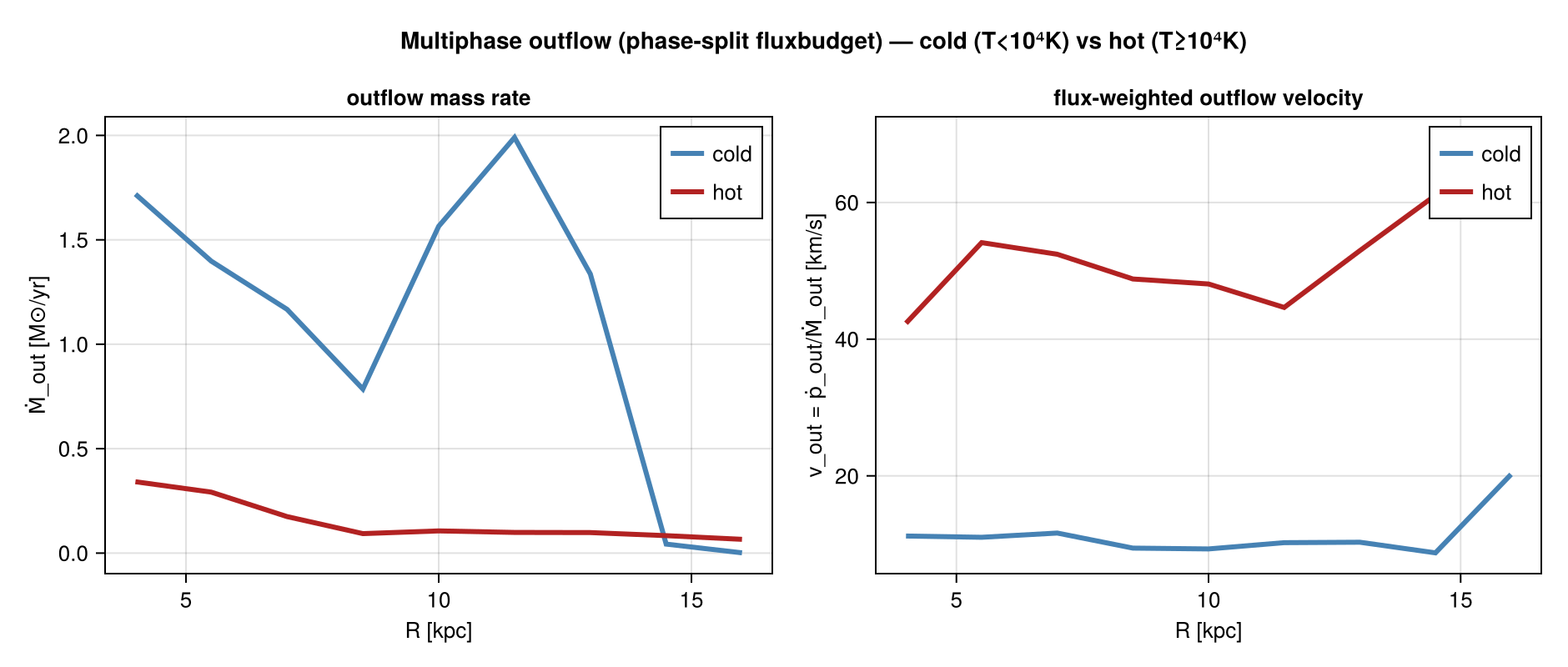
Phase outflow velocities — with phases, the mass-flux-weighted normal velocity of each phase is momentum.out / mass.out (Msol·km/s/yr ÷ Msol/yr = km/s), because momentum carries an extra v⊥:
fb = fluxbudget(gas; surface=:sphere, radius=10.0, shell_width=2.0, range_unit=:kpc,
                quantities=[:mass, :momentum],
                phases=(cold=s->getvar(s,:T,:K).<1e4, hot=s->getvar(s,:T,:K).>=1e4))
η_hot    = fb.components.hot.mass.out / sfr                          # per-phase loading
v_hot    = fb.components.hot.momentum.out / fb.components.hot.mass.out   # flux-weighted v_out [km/s]
This cleanly separates the multiphase wind — a slow, heavy cold fountain from a fast, light hot wind:
Other weightings & statistics. The budget is mass-flux weighted by construction (a flux is Σ q·v⊥), and fluxmap(:vr) gives the mass-weighted mean v⊥ per sky bin. For a volume-weighted (or median, percentile, dispersion …) velocity, take the cells from fluxshell and reduce them yourself — these can differ a lot, so pick the one your science needs:
sh = fluxshell(gas; surface=:sphere, radius=10.0, shell_width=2.0, range_unit=:kpc)
vr = getvar(sh, :vr_sphere, :km_s); m = getvar(sh, :mass, :Msol); V = getvar(sh, :volume, :kpc3)
out = vr .> 0
massw = sum(m[out].*vr[out]) / sum(m[out])          # mass-weighted mean outflow speed
volw  = sum(V[out].*vr[out]) / sum(V[out])          # volume-weighted (filling-factor) speed
using Statistics; med = median(vr[out]); p90 = quantile(vr[out], 0.9)
Off-axis surfaces (tilted cylinder, plane)
fluxbudget is a 3-D measurement, so the surface can be tilted. A sphere is orientation-free. A cylinder can be aligned to an arbitrary axis — a 3-vector, or :angmom (the gas net angular momentum L = Σ m·h, e.g. a galaxy's spin) — and a :plane surface measures the flux crossing a plane normal to axis (disk in-/outflow):
radius is the location of the surface and shell_width its thickness, but "location" depends on the geometry: for :sphere it is the spherical radius R (shell |r|∈[R±Δr/2]); for :cylinder the cylindrical radius (wall at R_cyl∈[R±Δr/2]); and for :plane it is the signed along-axis offset — the plane sits at axis·r = R (slab ∈[R±Δr/2]), so radius=5, axis=[0,0,1] is a plane 5 kpc above the midplane (use a negative radius for below, radius=0 for the midplane). In each case v⊥ is the velocity component along the surface normal (radial for sphere/cylinder, along axis for the plane).
# disk-edge flux in the angular-momentum frame
fb = fluxbudget(gas; surface=:cylinder, radius=15.0, shell_width=2.0, range_unit=:kpc, axis=:angmom)
# fountain/wind crossing a plane 5 kpc above the disk
fb = fluxbudget(gas; surface=:plane, radius=5.0, shell_width=2.0, range_unit=:kpc, axis=[0.,0.,1.])
The four surface choices, made concrete — each panel is the set of cells that fluxbudget integrates over for that geometry, shown edge-on over the same disk galaxy (use fluxshell to extract and visualize any of them):
![fluxbudget surface geometries (edge-on). *Sphere:* a spherical shell at radius R (its edge-on projection fills a disk of radius R). *Cylinder:* the vertical wall at cylindrical radius R — the disk-edge surface. *Plane:* a slab normal to the axis at along-axis position R (here R = 10 kpc above the midplane) — for measuring a wind/fountain crossing a height. *Off-axis cylinder:* the same wall tilted to an arbitrary `axis` (here `[0.5,0,1]`; use `axis=:angmom` to align with the disk spin).](../assets/features/flux_geometries.png)
Off-axis selection is cell-centre based (vs the axis-aligned path's cell-volume intersection), so it differs by ~10–15 % for thin shells — prefer shell_width ≥ a couple of cells. A cylinder's vertical extent defaults to 2·rout; override with height.
Bootstrap confidence intervals
Beyond the analytic standard error, pass bootstrap=N to attach percentile confidence intervals (resampling the shell cells with replacement; reproducible via bootstrap_seed, level set by ci_level, default 0.95):
fb = fluxbudget(gas; surface=:sphere, radius=30.0, shell_width=2.0, range_unit=:kpc, bootstrap=1000)
fb.rates.mass.net, fb.rates.mass.ci_net      # e.g. 0.03, (-1.94, 1.86) → consistent with balance
Each rate gains ci_in/ci_out/ci_net (lo, hi) (≈ NaN without bootstrap).
Visualizing the shell
fluxshell returns the exact thin shell that fluxbudget measured, as an ordinary HydroDataType — so you can see what was measured. Project it (it appears as a ring/annulus), or map the surface-normal velocity to see where on the shell gas flows in (< 0) versus out (> 0):
sh = fluxshell(gas; surface=:sphere, radius=30.0, shell_width=2.0, range_unit=:kpc)
println("shell cells           : ", length(sh.data))

fp = fluxprofile(gas; surface=:sphere, radii=5:5:50, shell_width=2.0, range_unit=:kpc)
println("radii [kpc]           : ", collect(fp.radius))
println("net Mdot(R) [Msol/yr] : ", round.(fp.net, digits=3))
shell cells : 19712
fluxprofile [sphere, mass]: 10 shells over R=5.0–50.0 kpc, Δr=2.0
radii [kpc] : [5.0, 10.0, 15.0, 20.0, 25.0, 30.0, 35.0, 40.0, 45.0, 50.0]
net Mdot(R) [Msol/yr] : [-0.892, 0.55, 0.009, -0.01, -0.006, 0.004, 0.001, 0.0, 0.0, 0.0]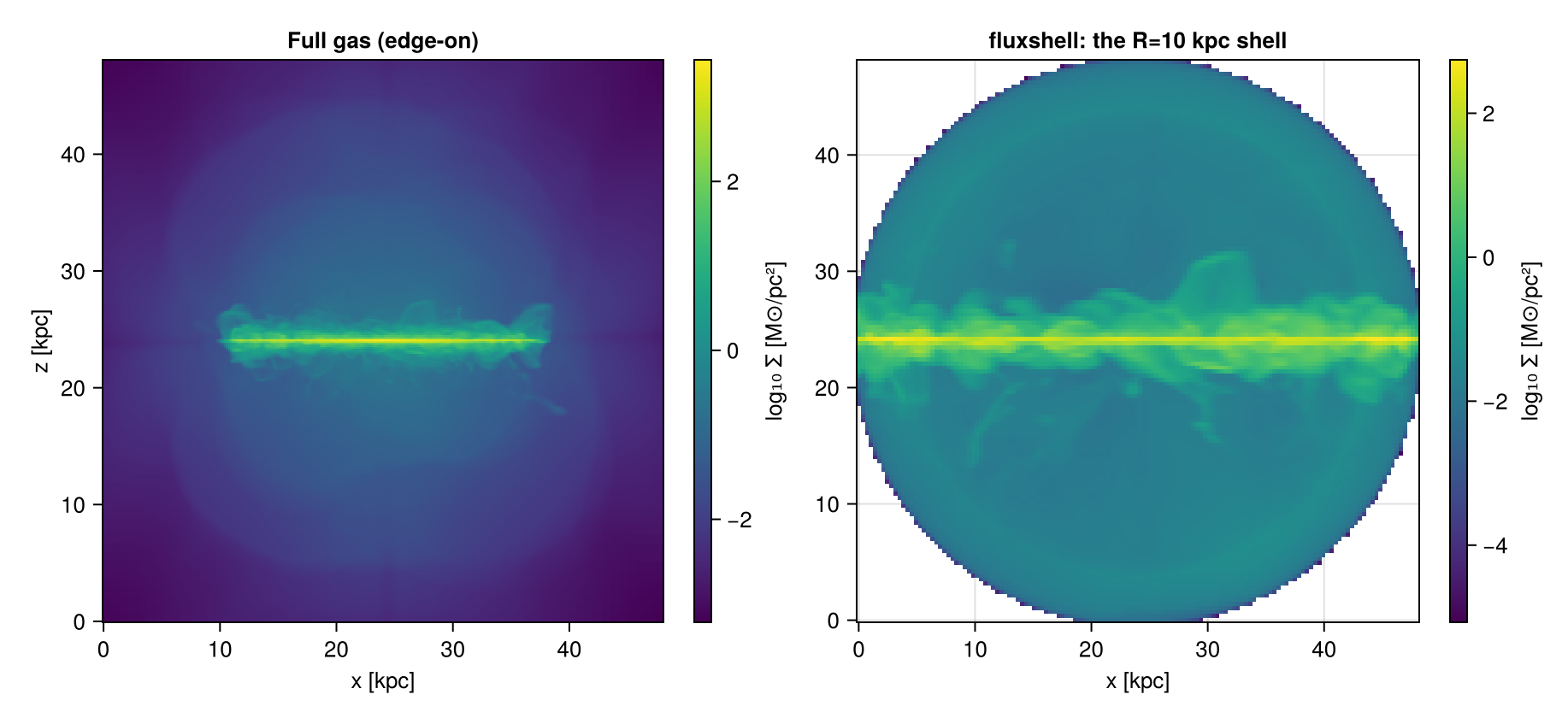
fluxshell and fluxbudget use the identical selection, so the visualization is guaranteed to show exactly the cells that entered the budget. fluxshell and fluxmap accept the same axis/:angmom and surface=:plane options as fluxbudget, so off-axis surfaces can be visualized too (the tilted fluxmap unrolls the cylinder about n̂ as a (φ′, z′) map, and its :mdot map still sums to the tilted budget).
The surface map (fluxmap)
projection of the shell flattens it onto a Cartesian plane and superposes the near and far side. For the true "where on the surface does gas flow in vs out" picture, fluxmap bins the shell by surface coordinates — (φ, cosθ) for a sphere (an equal-solid-angle sky map), (φ, z) for a cylinder (the wall unrolled) — so each cell sits at its own location, no superposition:
using CairoMakie
fm = fluxmap(gas; surface=:sphere, radius=30.0, shell_width=2.0, range_unit=:kpc, quantity=:vr)
fig = Figure(size=(560,420))
ax = Axis(fig[1,1], title="flux sky-map: mean v_perp [km/s] (red=out, blue=in)",
          xlabel="phi bin", ylabel="cos(theta) bin")
hm = heatmap!(ax, fm.map; colormap=:balance); Colorbar(fig[1,2], hm)
fig
FluxMapType [sphere @ R=30.0, Δr=2.0] quantity=vr [km_s]
(72, 36) grid (φ_deg × cosθ)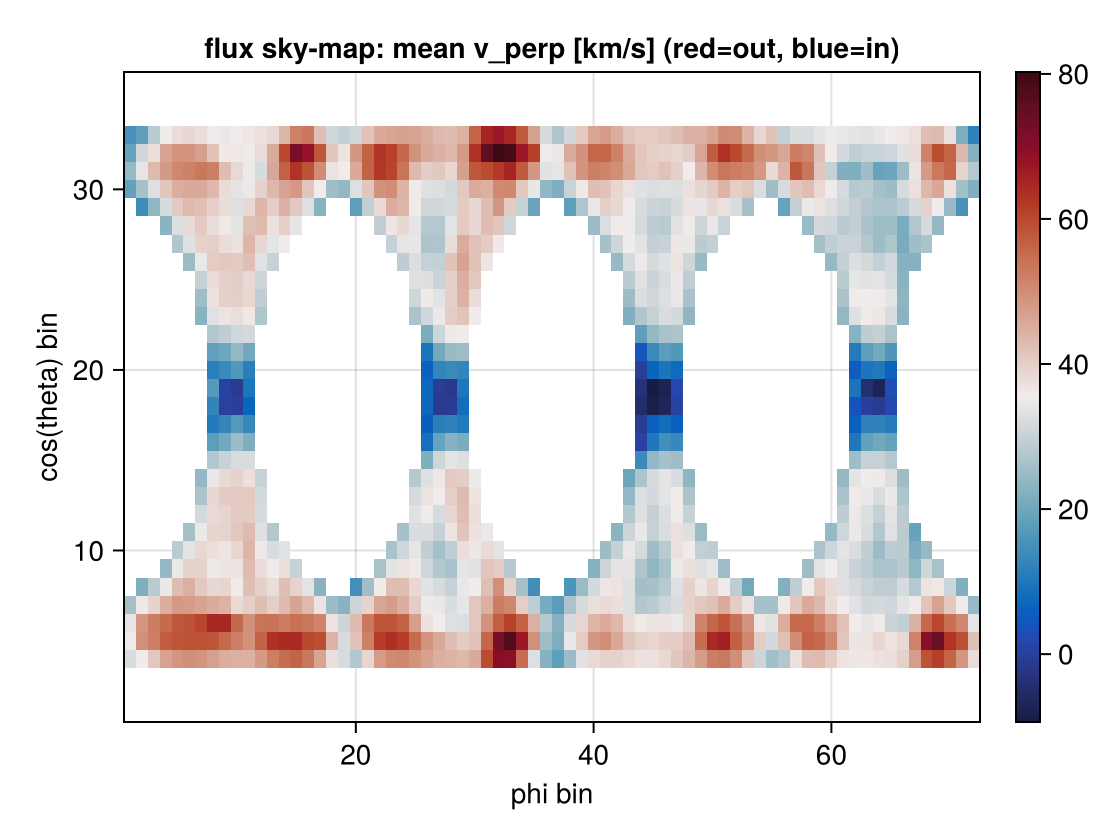
quantity=:vr maps the mass-weighted mean normal velocity (inflow < 0, outflow > 0); quantity=:mdot maps each bin's mass-flux contribution (Msol/yr), and its sum equals the net flux. fluxmap returns the arrays; it is not projection — different axes, no LOS superposition.
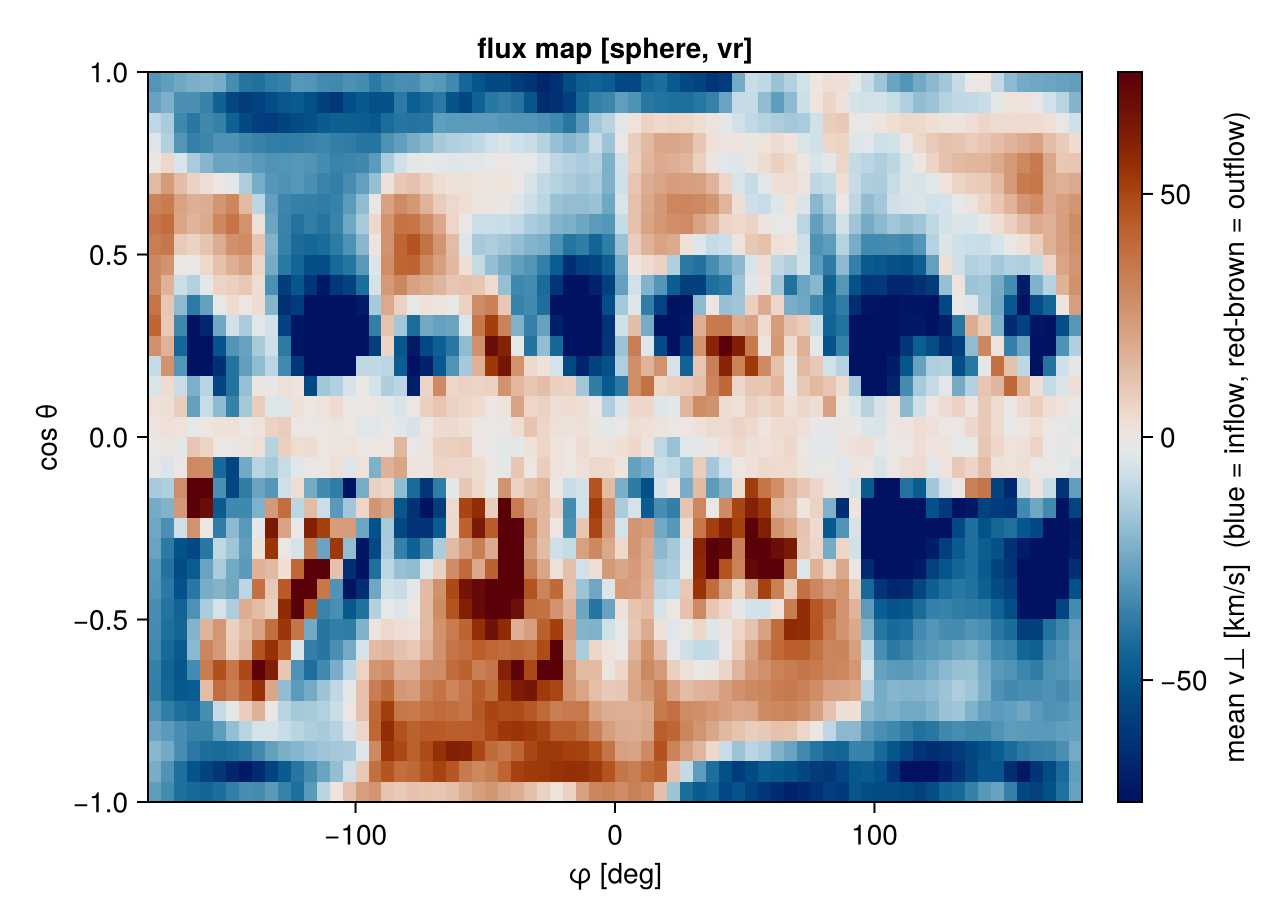
With a Makie backend loaded, fluxmapplot renders it directly (perceptually-uniform diverging :vik, blue-in/red-out, symmetric range clipped at the clip percentile — default 0.95 — so a few extreme cells don't wash out the contrast):
using CairoMakie
fig = fluxmapplot(fluxmap(gas; surface=:sphere, radius=30.0, shell_width=2.0, range_unit=:kpc))
Makie.save("flux_skymap.png", fig)
Statistics: uncertainty and the radial profile
Two ways to improve the statistics of a flux measurement, both built in:
More cells per shell — a wider shell_width puts more cells in the sum (the standard statistics-vs-localization tradeoff). Note fluxbudget does the cell-by-cell sum Σ mᵢ·v_r,i, which captures the density–velocity correlation exactly — not ⟨ρ⟩·⟨v_r⟩ over the shell, which would lose that correlation and bias the answer.
Sampling uncertainty — each rate carries err_in/err_out/err_net: the shot-noise standard error of the cell-sum. It is large when a few cells dominate the flux (an under-resolved or sparsely-sampled shell), so it tells you when a number is trustworthy:
fb = fluxbudget(gas; surface=:sphere, radius=30.0, shell_width=2.0, range_unit=:kpc)
fb.rates.mass.net, fb.rates.mass.err_net      # e.g. 0.03 ± 0.96  → consistent with balance
Radial flux profile — fluxprofile runs the budget across many radii at once, so you see where the flux is launched or converges and can pick a converged radius/width:
fp = fluxprofile(gas; surface=:sphere, radii=5:5:50, shell_width=2.0, range_unit=:kpc)
fp.radius, fp.net, fp.err_net      # net Ṁ(R) ± sampling error [Msol/yr]
# e.g. net < 0 in the disk (inflow) → net > 0 in the halo (outflow); a huge err flags a bad shell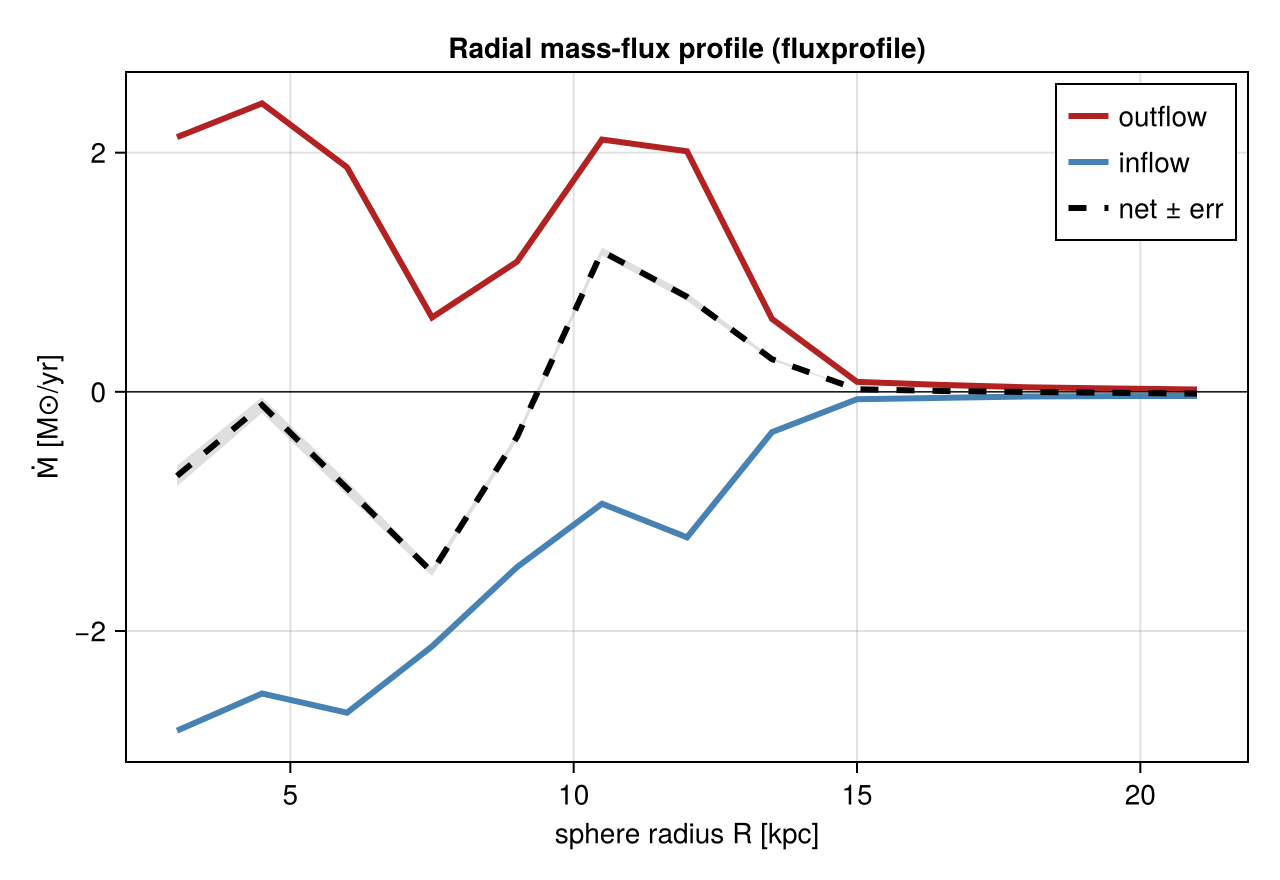
For the dominant snapshot-to-snapshot noise, time-average instead (see below).
Time evolution
fluxtimeseries maps fluxbudget over a snapshot series and assembles the rate versus time — the inflow/outflow history through a fixed surface:
loadfn = o -> gethydro(getinfo(o, "/sim"), verbose=false)
fts = fluxtimeseries(loadfn, 100:10:300, :sphere; radius=30.0, shell_width=2.0, range_unit=:kpc)
fts.t, fts.out, fts.in, fts.net      # time [Myr] and the rate history [Msol/yr]
Definition & correctness
The estimator is intentionally explicit and recorded on the result (surface, radius, shell_width, center) so the methodological choice is reproducible. The thin-shell estimator is verified against the analytic surface integral ∮ ρ v⊥ dA = 4πR²ρv⊥ (it converges as O((Δr/R)²)), the inflow/outflow split and net = in + out are exact, and the phase decomposition sums to the total — all guarded by the test suite, in the same spirit as Mera's projection/covering-grid conservation oracles.
API
The functions fluxbudget, fluxprofile, fluxtimeseries, fluxshell, fluxmap, fluxmapplot and the result types FluxBudgetType / FluxMapType are documented in the API reference. See also shellregion (the shell selection underneath) and Profiles & Phase Diagrams.